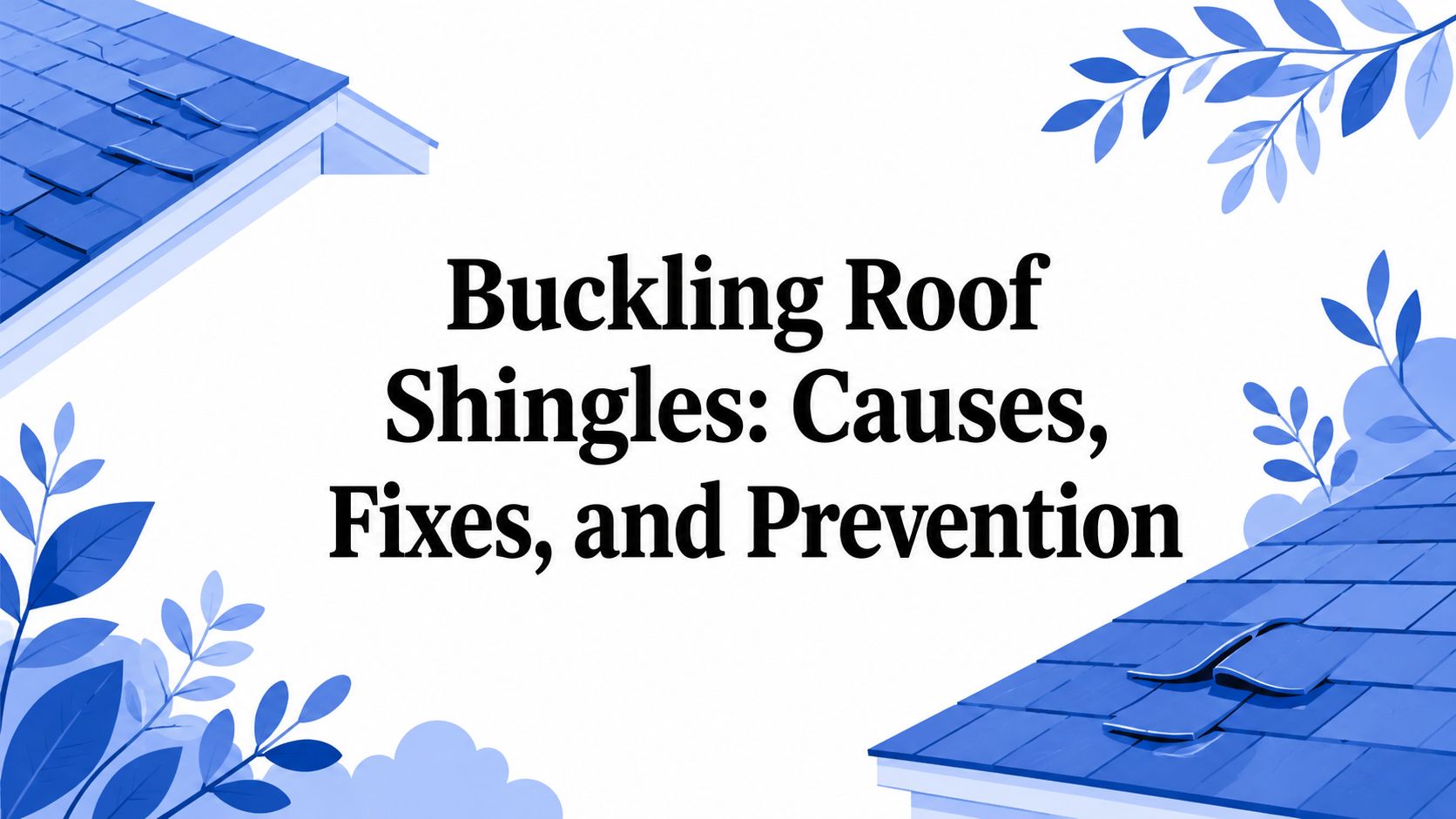
You notice it from the driveway first. A few shingles on your Columbus home no longer lie flat. They form shallow waves, raised ridges, or uneven lines that catch the afternoon light. The roof may still keep the rain out, so it's easy to assume the problem is cosmetic and can wait.
That assumption can be costly. Buckling roof shingles are often the visible result of movement below the shingles, involving the roof deck, underlayment, attic moisture, or installation details. Replacing only the raised shingles may improve the appearance briefly, but it won't stop the force creating the buckling.
Table of Contents
- Recognizing Buckling Shingles on Your Roof
- What Causes Shingles to Buckle
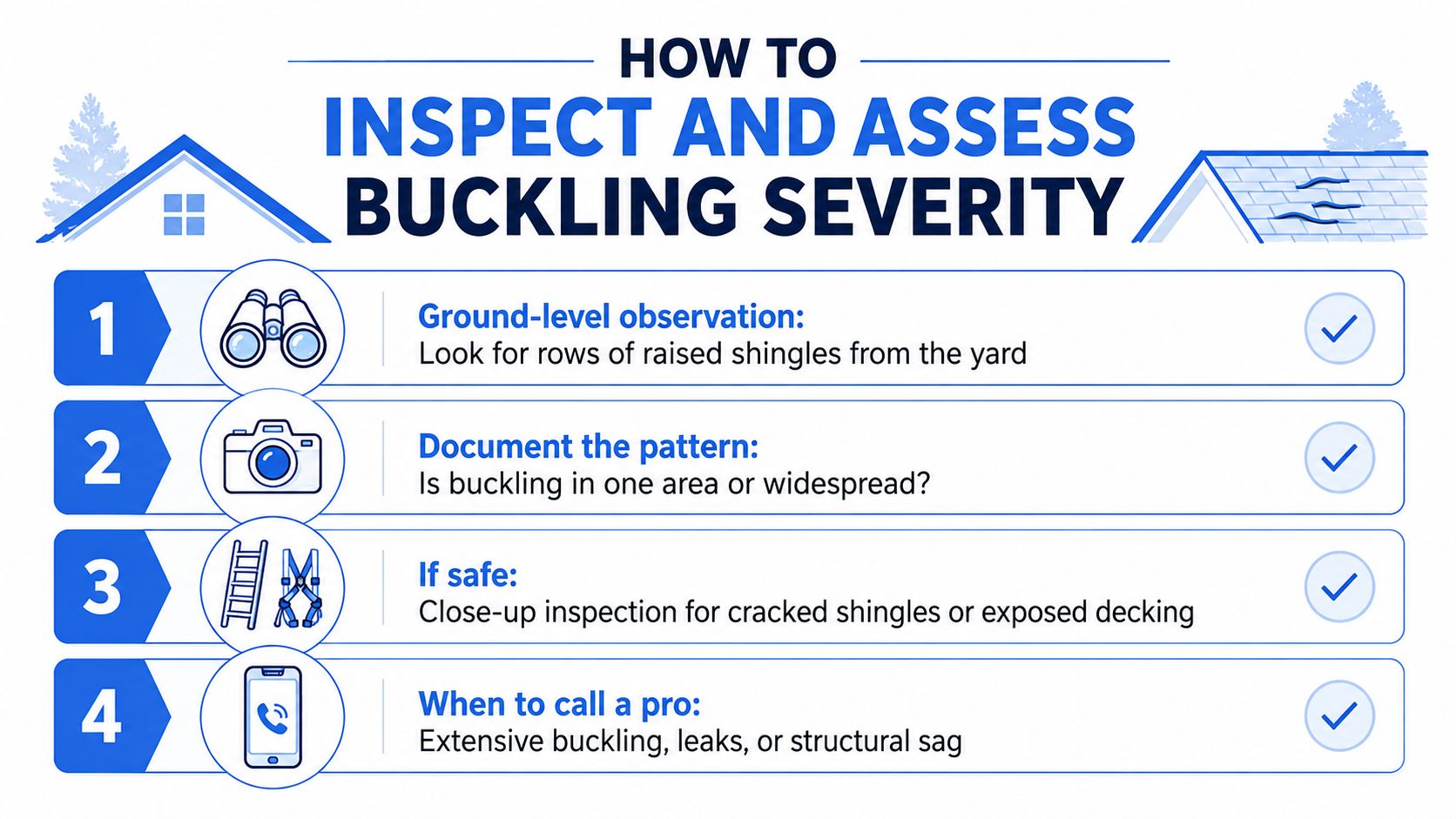
- How to Inspect and Assess Buckling Severity
- DIY Temporary Fixes Versus Professional Repairs
- Understanding Repair Costs and Insurance Coverage
- Preventing Future Shingle Buckling
- Next Steps for Columbus Homeowners
Recognizing Buckling Shingles on Your Roof
Buckling usually looks different from ordinary aging. From the ground, you may see long ridges, rippled rows, raised shingle edges, or wavy sections that interrupt the otherwise straight pattern of the roof. The distortion can run across several shingles or appear along a larger section of one roof slope.
A Columbus homeowner might first notice the issue after rain, during a sunny afternoon, or following a period of changing weather. Moisture and temperature changes can make an existing distortion more visible. If the shingles appear to flatten and rise repeatedly, that pattern deserves attention because the roof assembly may be moving beneath them.
Understanding the basic anatomy of asphalt roof shingles helps. Shingles form the weather-facing layer, but they rely on underlayment, roof decking, fasteners, flashing, ventilation, and moisture control to perform properly. A surface ridge can therefore point to a problem that isn't visible from the yard.
Buckling is not the same as every shingle defect
Curling usually involves corners or edges turning upward or downward. Blistering appears as small raised areas within the shingle surface, often associated with trapped air or moisture in the shingle itself. Missing granules leave rough, exposed-looking patches, but they don't normally create long, continuous ridges.
Buckling tends to look linear, irregular, and connected to the movement of the roof surface. It can affect a group of shingles in a row, rather than appearing as isolated surface damage.
From the ground, use binoculars to assess the overall pattern. Look for:
- Widespread distortion: Several rows or a broad roof section may indicate deck movement, underlayment problems, or attic conditions.
- Localized ridges: A small area can point to a local installation or moisture issue.
- Exposed fasteners or torn shingles: These increase the chance of water entry.
- Dark staining or sagging: These call for prompt professional attention.
You don't need to climb onto the roof to decide whether an inspection is appropriate. If the roof has active leaking, visible sagging, split shingles, or rapidly worsening buckling, treat it as urgent. Stable, isolated buckling without interior water damage may allow time to schedule a careful inspection, but waiting for a leak can turn a localized repair into a deck or structural problem.
What Causes Shingles to Buckle
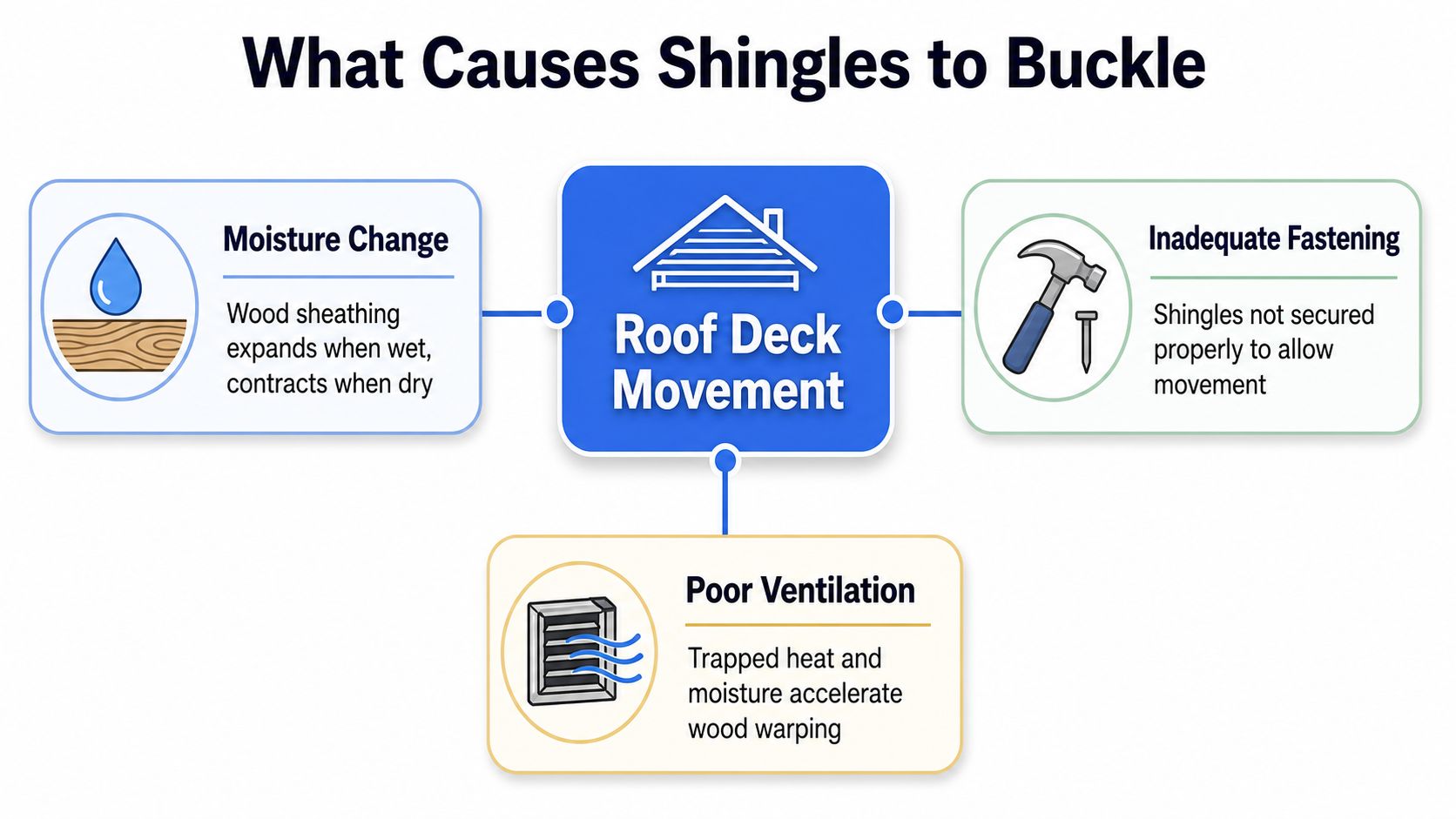
Buckling usually starts below the shingle surface. The two causes most consistently identified in roofing guidance are movement in the wood roof deck and wrinkles in the underlayment. Shingles often respond to pressure beneath them rather than failing independently. The Asphalt Roofing Manufacturers Association recognizes buckling as a defect that can occur on new roofs and reroofing projects, so the installation history matters as much as the visible damage. The association's explanation of buckled shingles describes the connection between the surface defect and movement within the roof system.
Wood sheathing absorbs and releases moisture. As boards or panels expand and contract, they can press against adjacent pieces. Installers generally leave 1/8 inch of spacing between roof sheathing boards to allow for natural wood movement. If boards are fitted too tightly, seasonal expansion can push upward into the underlayment and shingles.
Underlayment creates another concealed source of distortion. Roofing felt or synthetic underlayment should lie flat across the deck. A wrinkle, fold, or poorly secured section can create a ridge that transfers through the shingles. Replacing only the shingle removes the visible cover while leaving the raised material beneath it.
Moisture ties the causes together
Attic moisture may result from condensation, roof leaks, or household exhaust that has not been routed outdoors. Bathroom fans, dryers, and other appliances that discharge into the attic add moisture where the roof deck needs to dry. Poor ventilation slows that drying and can keep the deck moving through seasonal changes.
Research on unvented roofs in hot-humid climates found that OSB or plywood sheathing can absorb enough moisture to narrow the gap between adjacent sheets, wrinkling roofing paper and shingles. Building Science Corporation's research on unvented roofs supports treating buckling as a roof-assembly moisture problem when the pattern and attic evidence point that way.
Storms can add risk through wind-driven rain, fallen branches, or concealed roof damage. Homeowners recording those conditions may use AMPM Restoration Services storm damage help when organizing photos, damage records, and next steps.
Heat can speed up movement, but it rarely explains buckling by itself. What heat does to asphalt roof shingles is most relevant alongside moisture, inadequate ventilation, or installation defects. A reliable diagnosis examines the complete roof assembly rather than blaming the shingle surface automatically.
How to Inspect and Assess Buckling Severity
Start from the ground. Walk around the property and use binoculars to inspect every roof slope from several angles. Sunlight moving across the shingles can reveal ridges that aren't obvious in flat lighting, while a view from the side often shows the height and continuity of the distortion better than a straight-on view.
Record what you see before anyone repairs it. A contractor or insurance adjuster needs more than a single close-up image.
- Photograph the whole slope: Show where the buckling sits in relation to ridges, valleys, chimneys, and roof edges.
- Capture closer views: Photograph raised edges, split shingles, exposed underlayment, missing granules, and damaged flashing.
- Note the timing: Write down when you first noticed the condition and whether it changed after rain, heat, wind, or a storm.
- Check indoors: Look at ceilings, upper walls, attic rafters, and insulation for staining, dampness, or condensation.
What the pattern can tell you
A broad field of buckling across one slope suggests a shared cause, such as deck movement, underlayment installation, or ventilation. An isolated ridge near a roof penetration may point toward localized moisture or installation trouble. The pattern doesn't prove the diagnosis, but it tells the inspector where to look first.
An attic check can reveal clues without stepping onto the roof. Look for blocked soffit paths, missing or restricted exhaust, damp sheathing, condensation on nails, and household exhaust terminating in the attic. Don't crawl through an unfamiliar attic if the floor is incomplete, insulation conceals framing, or the roof structure appears damaged.
Stable appearance versus active damage
Stable buckling may remain visible without obvious change for a period, but that doesn't make it harmless. Active buckling is more concerning when ridges are spreading, shingles are cracking or splitting, water is entering, or the roof deck is sagging. Those conditions warrant prompt professional evaluation.
Safety rule: Never climb a wet, steep, or visibly damaged roof to confirm what binoculars already show. A roof inspection should protect the homeowner as well as the building.
A qualified inspector should assess shingles, underlayment, decking, flashing, ventilation, and attic moisture together. That combination is what separates a useful diagnosis from a quick surface opinion.
DIY Temporary Fixes Versus Professional Repairs
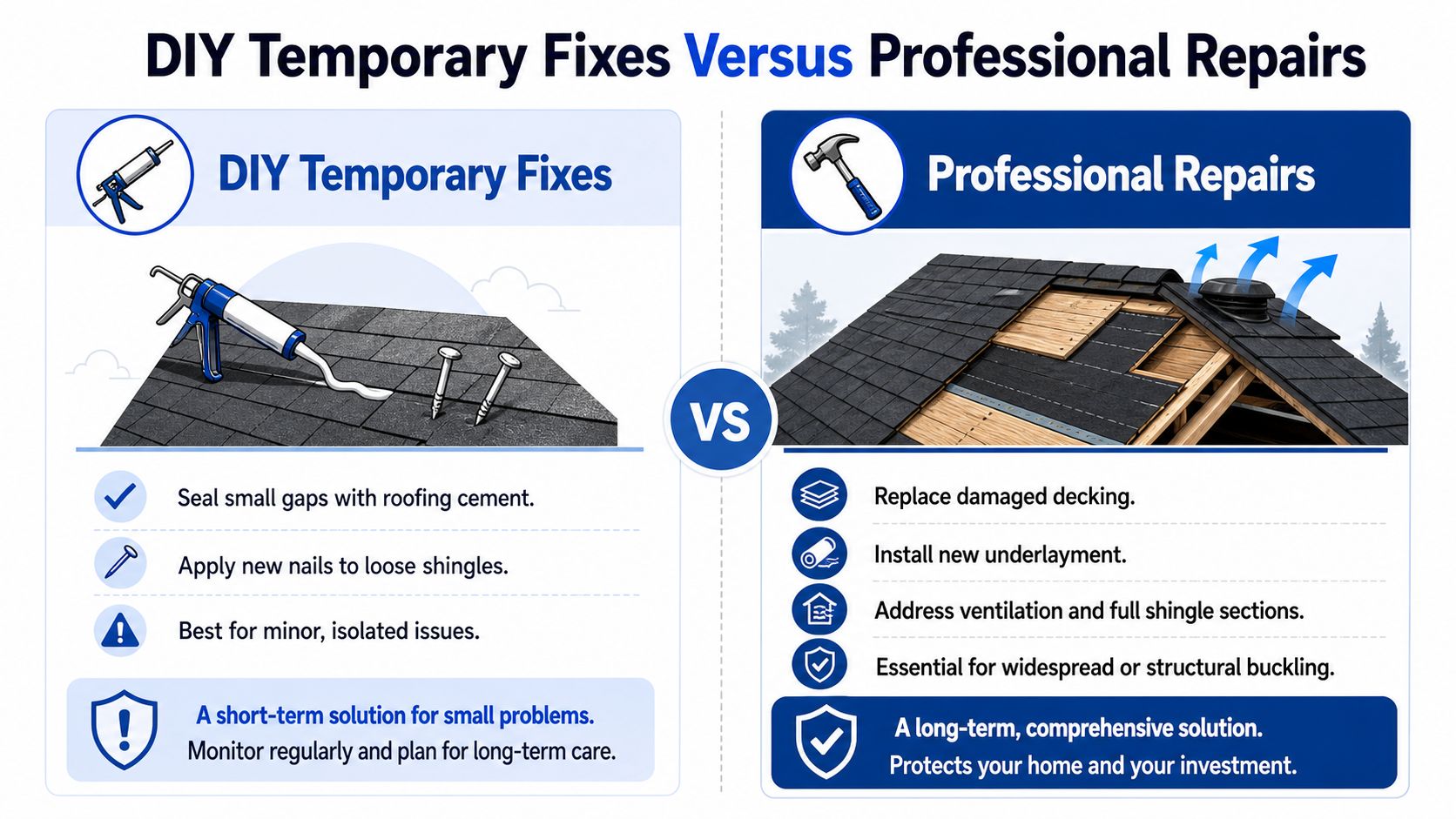
A homeowner may be able to limit immediate exposure, but a temporary patch isn't a structural repair. Roofing cement can hold down a small lifted edge, and a correctly selected replacement shingle can address one damaged piece. Neither solution repairs a swollen deck panel, folded underlayment, or attic moisture that continues to affect the roof.
| Temporary homeowner action | What it can do | What it cannot do |
|---|---|---|
| Apply roofing cement to a small loose edge | Limit immediate lifting or water entry | Stop movement beneath the shingle |
| Add a correctly placed fastener to a loose shingle | Secure a minor isolated defect | Correct widespread installation failure |
| Replace one visibly damaged shingle | Restore one small area | Repair wrinkled underlayment or damaged decking |
| Cover an active leak temporarily | Reduce short-term interior exposure | Provide a permanent weatherproof roof system |
Temporary work also carries risks. Foot traffic can remove granules and weaken sealant bonds. A nail placed in the wrong location can create a new leak path. Cement spread over a moving ridge may conceal evidence needed for diagnosis and make later removal harder.
What professional repair involves
A proper repair starts below the visible surface. The roofer may lift or remove affected shingles, inspect the underlayment, check the decking for movement or moisture damage, and review ventilation from both the attic and roof exterior. If the deck is uneven or damaged, the crew may need to replace that section before installing new underlayment and shingles.
Replacement shingles should match the existing roof as closely as practical. Differences in color and weathering can leave a patched area visible even when the installation is sound. The repair also has to tie into valleys, wall intersections, pipe flashings, and other details that direct water away from the structure.
Repair or replacement
Partial repair can make sense when buckling is localized, the surrounding roof system remains serviceable, and the underlying cause can be corrected without opening large areas. Replacement becomes more reasonable when buckling is widespread, the deck shows extensive movement or damage, or the asphalt shingles are approaching the commonly cited 20 to 30 year service-life range. Earlier guidance on buckling causes and aging provides useful context for that assessment.
The written scope should identify inspection, material coordination, weather planning, installation, and cleanup. Ask whether it addresses the deck, underlayment, ventilation, and moisture source, or only replaces raised shingles. A promise to flatten every ridge without examining below the shingles treats a system problem as a cosmetic defect.
Understanding Repair Costs and Insurance Coverage
Buckling repair doesn't have one fixed price because the visible defect can represent very different scopes of work. A roofer may need to replace a few shingles, open a larger roof section, repair underlayment, replace damaged decking, correct ventilation, or recommend a full replacement. The extent of the buckling and the condition below it drive the decision more than the appearance of one raised shingle.
Access affects labor. A simple, low-slope section is easier to inspect and repair than a steep roof with multiple valleys, dormers, skylights, or difficult staging. Material matching, decking removal, flashing work, attic access, disposal, and local labor conditions can also change the written estimate. Homeowners should ask whether the proposal includes the underlying cause or only the visible shingles.
Insurance requires a separate analysis. Buckling that results from ordinary aging, long-term moisture exposure, or installation problems is generally treated differently from damage caused by a covered storm event. Wind, hail, a fallen tree, or sudden water intrusion may justify a claim, but the policy language and evidence control the outcome.
Build the evidence before filing
Document the roof from ground level and keep the original photos. Add interior images, maintenance records, invoices, dates of severe weather, and notes about when the buckling appeared. A professional inspection report can help distinguish storm damage from pre-existing wear, although no contractor can guarantee an insurer's decision.
Don't authorize emergency reconstruction before understanding the scope unless active water entry requires immediate protection. Ask for a written estimate that separates shingle work, underlayment, decking, ventilation, flashing, and related exterior repairs. That separation makes it easier to compare proposals and discuss coverage.
Repair value versus replacement value
A localized repair may preserve a serviceable roof while addressing the actual source. Replacement may offer better long-term value when repairs would leave extensive aged materials in place or when widespread buckling suggests that multiple roof-system components have reached the end of their useful service.
Manufacturer warranty terms also matter. A warranty may address material defects under its conditions, but it doesn't automatically cover poor ventilation, improper deck preparation, or installation errors. Read the material and workmanship coverage separately, and keep the contractor's documentation after the work is complete.
Preventing Future Shingle Buckling
Prevention starts below the shingles. A roof needs a way to release heat and moisture from the attic, and the most reliable arrangement uses soffit or eave intake together with ridge exhaust. A manufacturer bulletin identifies a common benchmark of 1 square foot of vent area per 300 square feet of attic floor space, with airflow divided between intake and exhaust, as explained in building guidance on deck movement and attic ventilation.
Another manufacturer source identifies a common code benchmark of 1/150 net free ventilating area, with a possible reduction to 1/300 when qualifying conditions such as a proper vapor barrier and balanced upper ventilation are present. Atlas Roofing's buckling bulletin explains why intake and exhaust must work as a system. Adding a ridge vent without usable intake can leave the airflow path incomplete.
Control moisture at its source
Bathroom fans, dryers, dishwashers, and other appliances should discharge outdoors, not into the attic. The cited building-science guidance warns that appliance exhaust in the attic can add moisture and contribute to roof-sheathing problems. Check duct connections, insulation around ducts where appropriate, and visible signs of condensation.
Homeowners can clear leaves from gutters, keep visible soffit openings free of debris, and watch for staining after severe weather. A contractor should evaluate blocked ventilation paths, inadequate intake, vapor-control details, and roof-deck condition.
Install the roof to move naturally
During a roof replacement, ask how the installer will handle deck spacing, damaged panels, fastener placement, and underlayment installation. Technical guidance identifies 1/8 inch, and in some manufacturer guidance 3 millimeters, of spacing between roof-deck panels as a practical movement allowance. The technical bulletin on asphalt-shingle buckling explains how inadequate spacing can telegraph movement into the shingles.
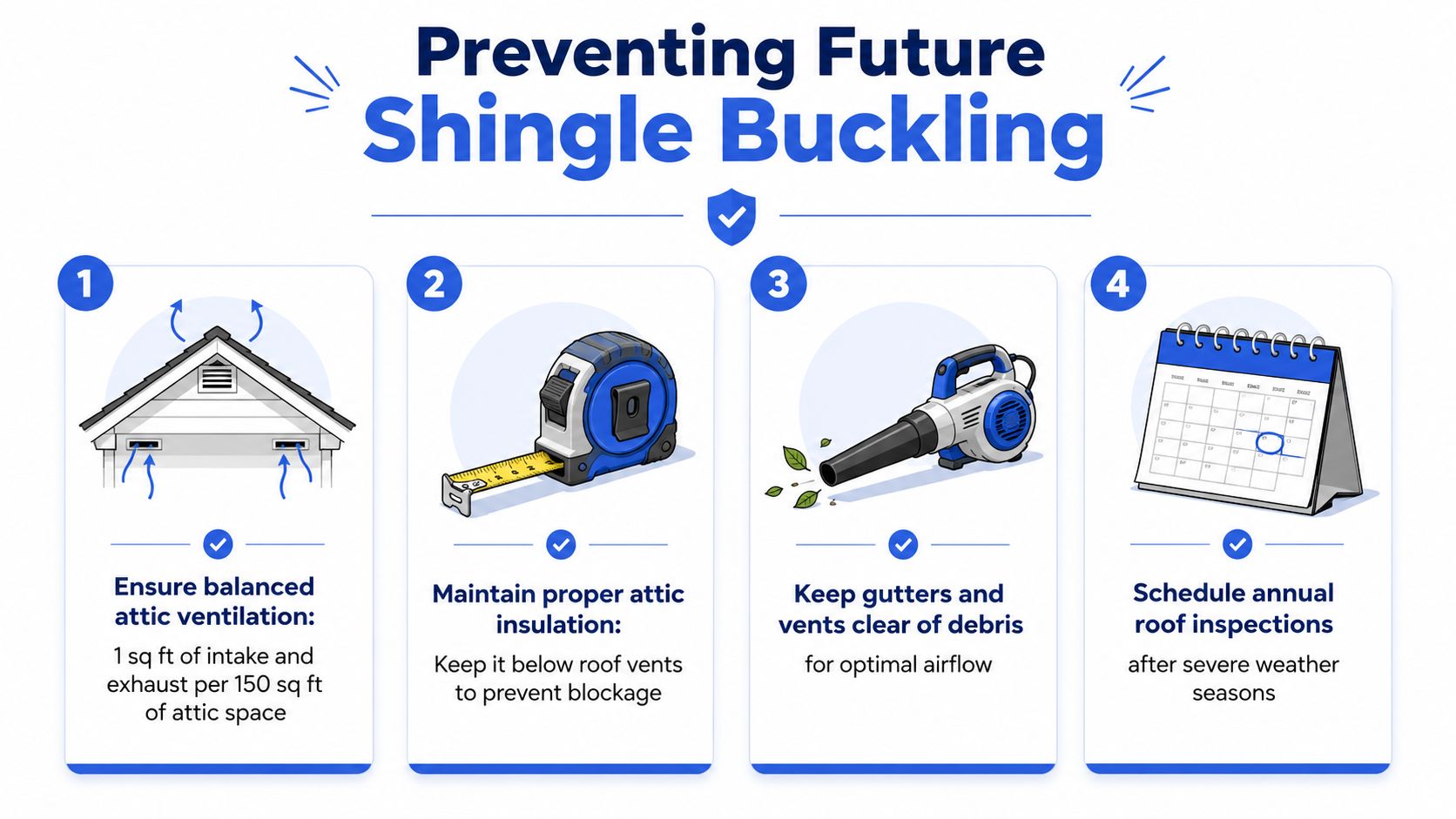
Use preventive roof maintenance guidance to organize recurring checks. A professional should inspect after major weather and whenever buckling, leaks, or attic moisture appears. Maintenance won't correct a faulty installation, but it can reveal movement before it spreads.
Next Steps for Columbus Homeowners
Don't begin with a shingle replacement quote based only on a driveway view. Begin with an inspection that answers four questions: What is moving, where is moisture coming from, how much of the roof is affected, and can the existing system be repaired reliably?
A quality inspection should cover the roof surface, underlayment where accessible, roof decking, flashing, ventilation, attic conditions, and interior evidence of water entry. The contractor should explain which observations are confirmed and which require opening the roof. That distinction matters because buckling can look simple while hiding a more involved repair.
Choose a licensed and insured contractor familiar with Columbus and central Ohio conditions. Ask for proof of insurance, licensing information where applicable, references or review history, and a written scope before authorizing work. A responsible proposal should identify the suspected cause, recommended repair, materials, ventilation changes, decking allowances if needed, cleanup, and warranty terms.
Questions to ask before signing
- Cause: Is the buckling related to decking, underlayment, moisture, ventilation, fastening, or more than one condition?
- Scope: Will the crew remove shingles to inspect the material beneath them?
- Contingencies: What happens if damaged decking is found after work begins?
- Warranty: Which coverage comes from the manufacturer, and which comes from the contractor?
- Insurance: Can the contractor document storm-related conditions without promising claim approval?
- Timeline: When will work begin, how will weather affect it, and how will the crew protect landscaping and interiors?
For an insurance claim, preserve damaged materials when practical, photograph conditions before repairs, and keep all written communication. A contractor can provide documentation and explain roof findings, but the insurer determines coverage under the policy.
Buckling is easier to manage before it becomes an interior leak, softened deck, or broader roof failure. Schedule an inspection when the condition is first visible, especially if the buckling is spreading, the attic is damp, or the roof has recently experienced severe weather.
HIBCO ROOF LLC provides inspections, shingle repairs, full roof replacements, storm and hail damage documentation, and related exterior work for Columbus-area homeowners. Visit HIBCO ROOF LLC to request a free inspection and written estimate focused on the cause of your buckling roof shingles, not just the visible surface.