Class 4 is the highest UL 2218 rating for hail-resistant shingles. It means the shingle survived a 2-inch steel ball dropped from 20 feet without cracking, splitting, rupturing, or opening on the back side.
That sounds reassuring, especially after a Columbus storm leaves the yard covered in ice pellets and branches. But a laboratory impact rating isn't the same thing as a hail-proof roof. Wind-driven strikes, repeated impacts, aging materials, fastener placement, roof slope, and installation quality still determine what happens over your house.
Table of Contents
- What Hail Resistant Shingles Are and Why Columbus Homeowners Care
- How Impact Ratings Like Class 4 Actually Work
- Materials and Construction Behind Hail Resistant Designs
- What Class 4 Does Not Promise in Real Storms
- Insurance Discounts, Claims, and Real Cost Considerations
- Installation and Inspection Tips That Change Outcomes
- Choosing the Right Time to Upgrade and Getting a Free Inspection
What Hail Resistant Shingles Are and Why Columbus Homeowners Care
A Franklin County homeowner recently noticed what looked like dime-sized dimples on his shingles after a June storm. He hadn't seen anything from the ground. The damage became apparent only after a roofer inspected the attic side and found impact-related changes that weren't obvious from the driveway.
That situation is common enough to change how a careful contractor talks about hail resistant shingles. These products are engineered to handle impact with less risk of cracking, granule loss, or fracture through the shingle substrate. They aren't thicker versions of ordinary roofing. Their asphalt blend, reinforcement, surface treatment, and sometimes their entire panel construction are designed to manage impact energy differently.
Columbus homeowners need to think beyond the word “resistant.” Central Ohio gets severe thunderstorms and hail events that can affect isolated neighborhoods rather than every street in the county. One home may escape with no visible damage while another nearby roof develops bruising, exposed matting, damaged vents, or fractured shingles. Roof age and exposure matter, too.
A roof covering is only one part of the assembly. Underlayment, flashing, starter strips, ridge caps, ventilation, and fastening all influence whether a roof remains watertight after a storm. The practical distinction between a product upgrade and a system upgrade is explained well in this guide to what roof shingles are.
Practical rule: Treat the impact rating as one specification to verify, not as a promise that the roof will never be damaged.
The useful questions are straightforward. How does a shingle earn its rating? Which materials are available to Columbus homeowners? What does laboratory testing reveal, and what does it leave out? Finally, how does an insurer treat the upgrade during a claim or policy review?
How Impact Ratings Like Class 4 Actually Work
UL 2218 gives homeowners a measurable way to compare impact resistance. The test uses steel balls dropped onto roofing materials from controlled heights. The product is then inspected for cracking, splitting, rupturing, fracture, or another opening visible on the back of the shingle. The APEX NANO impact resistance guide offers useful background on how impact-resistance testing works across roofing materials.
The Class 4 procedure is the one most homeowners hear about. A 2-inch steel ball is dropped from 20 feet, and the shingle must show no qualifying damage on its back side to pass. The test also uses two impacts in the same location, so the product can't pass merely because the first strike landed on an unusually strong area. That repeated-hit detail matters because hail often hits a limited roof area more than once.
The four UL 2218 classes
| Class | Steel Ball Diameter | Drop Height |
|---|---|---|
| Class 1 | 1.25 inches | 12 feet |
| Class 2 | 1.5 inches | 15 feet |
| Class 3 | 1.75 inches | 17 feet |
| Class 4 | 2 inches | 20 feet |
The class number doesn't describe a percentage of hail damage prevented. It identifies the most demanding steel-ball condition the product passed under the standard. Class 4 is the highest tier, while Class 1 is the lowest tier in this framework. Class 3 uses a 1.75-inch ball from 17 feet, and Class 4 advances to a 2-inch ball from 20 feet, with the pass condition focused on visible damage at the back of the shingle. The UL 2218 impact-resistant shingle data sheet provides a concise description of the classification approach.
What the test leaves out
UL 2218 doesn't recreate every condition on a Columbus roof. It doesn't account for wind pushing hail at an angle, debris striking nearby, years of ultraviolet exposure, poor nail placement, weak flashing, or a roof deck that has shifted. It also doesn't establish how an entire roof assembly will perform when ridge caps, valleys, vents, and fastener lines receive different impact forces.
That limitation doesn't make the rating useless. It makes the rating a baseline. When comparing two products, a verified Class 4 certification tells you one product met a defined impact threshold. It doesn't tell you that every Class 4 product will perform identically in a real storm. Metal roofing and asphalt systems also have different design considerations, which are worth comparing in this metal roofing versus asphalt guide.
Materials and Construction Behind Hail Resistant Designs
The products Columbus homeowners usually see in estimates fall into a few practical categories. Their behavior under impact differs because the materials manage force in different ways. The right choice depends on more than the label. Roof pitch, attic ventilation, structural capacity, appearance, and the kind of storms the property experiences all belong in the conversation.
Flexible asphalt options
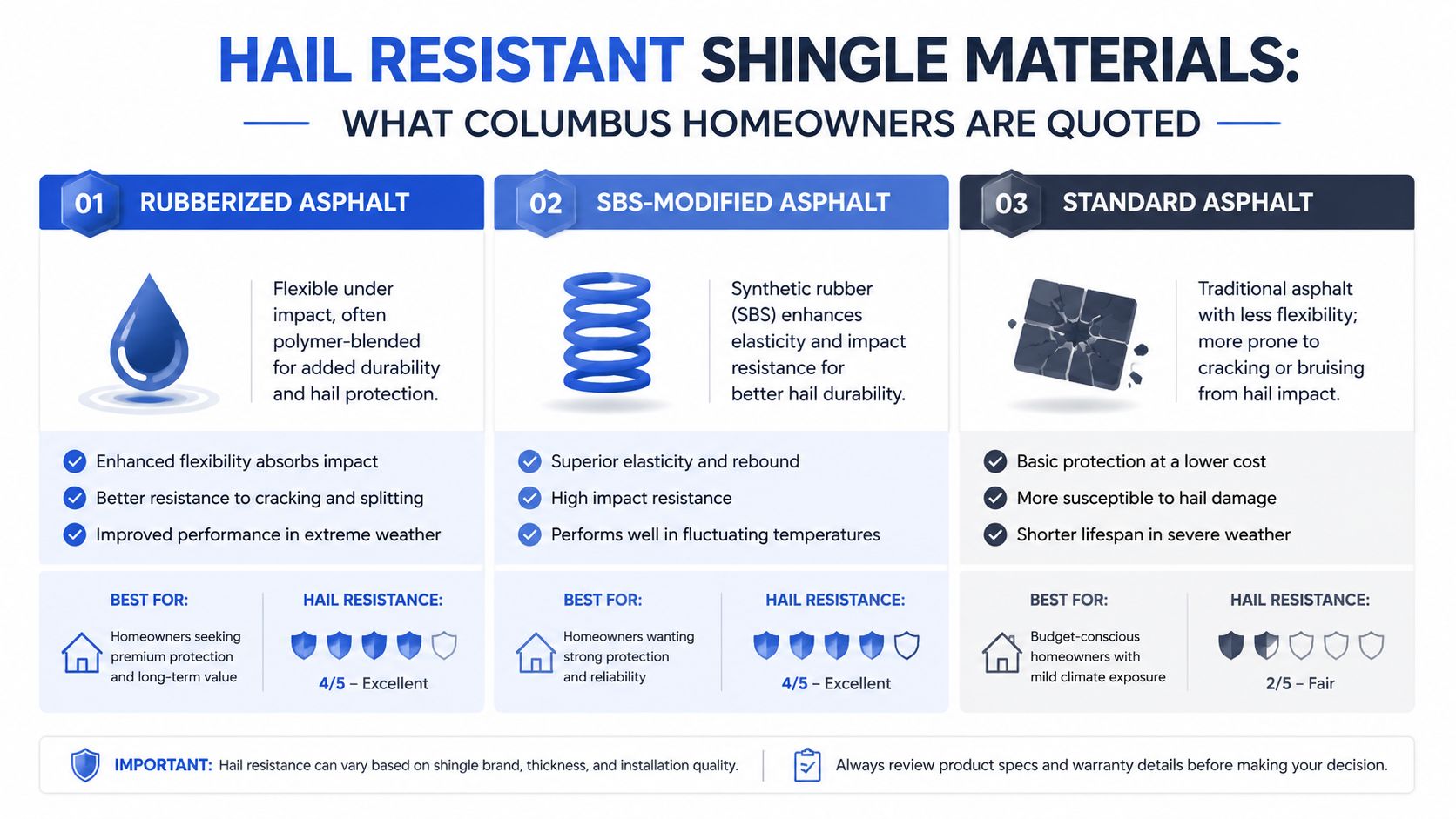
Rubberized asphalt is often polymer-blended so the shingle can flex when struck. Instead of behaving like a brittle sheet, it absorbs part of the impact and rebounds. That flexibility can help reduce cracking and granule loss, although the product still needs correct fastening and sealing.
SBS-modified asphalt uses synthetic rubber polymers in the asphalt. The material is designed to stretch and recover, allowing it to bend under force without fracturing as readily as conventional asphalt. One major manufacturer identifies products that meet both FM 4473 and UL 2218 Class 4 standards, demonstrating that some products undergo more than one impact-resistance protocol, as described for IKO Dynasty shingles.
Metal and composite choices
Metal panels, commonly aluminum or steel, disperse impact energy across a broader surface. They can resist penetration effectively, but hail may still leave visible dents, particularly where the panel spans over open space. Rain and hail noise can also be more noticeable unless the roof assembly includes suitable insulation and underlayment.
Composite panels and tiles use engineered polymers to imitate slate, shake, or tile while reducing the weight associated with some traditional roofing materials. They can offer a different appearance and impact behavior, but product-specific testing matters. “Composite” isn't a universal performance category.
Matching the roof to the house
A steeper roof changes the angle at which hail meets the surface. Attic ventilation helps manage heat and moisture conditions that affect roofing materials over time. Structural review becomes especially important when considering heavier systems, while appearance and dent visibility matter to homeowners who care about how the roof looks after a storm.
Impact-resistant asphalt is often the most straightforward path for an existing Columbus home because it fits familiar installation methods and styles. Metal or composite systems may make sense when the homeowner also wants a different service profile or appearance. The cost premium for impact-resistant products can be substantial, so the estimate should explain the full assembly, not just the shingle name.
What Class 4 Does Not Promise in Real Storms
The most useful recent evidence is the IBHS 2025 impact-resistant shingle ratings update. IBHS tested 24 shingles, and only 18 earned a “Good” rating. Five were rated “Marginal,” one was rated “Poor,” and none earned “Excellent,” according to the IBHS ratings update.
That result should change how homeowners read a sales proposal. A product can carry a Class 4 label and still perform differently from another Class 4 product in a broader head-to-head evaluation. The factory test answers a narrow question: did the shingle withstand a defined steel-ball impact under controlled conditions? It doesn't answer whether the entire roof will survive a severe storm without bruising, denting, cracking, or granule loss.
| Performance Tier | Products Earning It | What it Means for Field Results |
|---|---|---|
| Good | 18 of 24 | Better relative performance in the IBHS comparison, but not a guarantee against storm damage |
| Marginal | 5 of 24 | The product met its stated impact classification but showed more limited results in the broader evaluation |
| Poor | 1 of 24 | The product performed weakly relative to the tested group |
| Excellent | None | No tested product reached this tier |
Why field conditions change the outcome
Large hail, wind-driven angles, and repeated strikes in one area can exceed what a controlled test represents. Age can change flexibility and surface condition. Installation can place stress along fastener lines, valleys, transitions, and roof edges.
IBHS testing has also highlighted different failure patterns among materials. SBS-modified asphalt can crack, metal can dent, and some products can develop fractures along fastener lines. Those outcomes don't mean Class 4 is meaningless. They mean the label should guide product selection while the assembly and installation determine how much of that potential reaches the finished roof.
The honest promise is risk reduction, not storm immunity.
For a Columbus homeowner, a Class 4 shingle is a reasonable specification in a hail-prone area. It isn't a warranty against every future event, and the warranty language should be read separately from the impact rating.
Insurance Discounts, Claims, and Real Cost Considerations
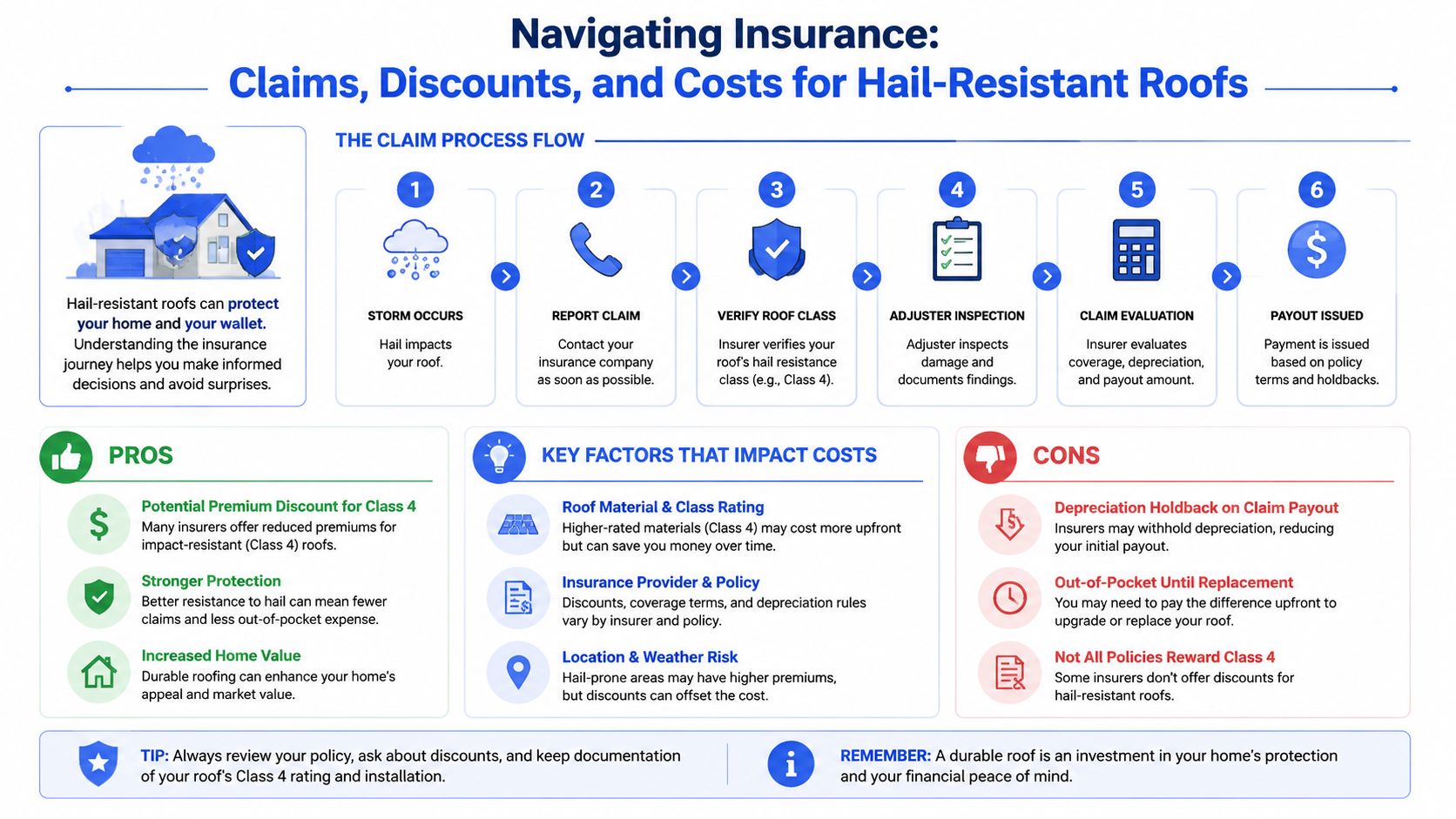
A hail claim usually starts with a phone call, but the paperwork often determines how smoothly it finishes. The homeowner reports the date of the storm, the insurer schedules an adjuster, and the inspection compares visible and functional damage across the roof and exterior. If the policy pays replacement-cost benefits, the insurer may first issue an amount based on the covered loss, then release withheld depreciation after completed work and documentation.
Class 4 status can matter during underwriting and claims, but homeowners shouldn't assume every carrier handles it the same way. The insurer may ask for a manufacturer certification letter, proof of purchase, or photographs of the bundle wrapper showing the rating. Keep those records with the final invoice and installation documentation.
What to verify before relying on a discount
- Carrier requirements: Ask whether the insurer recognizes UL 2218 Class 4, FM 4473, or a specific product list.
- Policy language: Check whether the policy covers functional damage, cosmetic damage, or both.
- Deductible treatment: Ask whether an impact-resistant roof changes the deductible or only affects the premium.
- Claim documents: Save certification, invoices, product labels, photographs, and the contractor's completion information.
A homeowner comparing estimates should also separate the shingle price from the full installed roof price. The premium for impact-resistant roofing can be worthwhile, but the break-even point depends on the carrier's terms, the home's insurance cost, the roof's condition, and how long the owner expects to stay. A discount can reduce ongoing expenses, but it doesn't automatically recover the upgrade cost.
For practical storm-policy questions, homeowners can also review Select Insurance Group, Inc.'s storm advice. The important point is to ask the carrier before installation, not after a storm, because documentation requirements and cosmetic-damage provisions can affect the claim.
The impact-resistant shingles cost guide can help frame the roofing side of that comparison. Focus on the written scope, product certification, tear-off, underlayment, flashing, ventilation, labor, and disposal. A low shingle-only quote may not represent a complete storm-resilient roof.
Installation and Inspection Tips That Change Outcomes
A Class 4 shingle can't compensate for careless installation. Impact forces travel through the shingle, fasteners, underlayment, roof deck, and framing. If a nail is overdriven, underdriven, misplaced, or installed at the wrong angle, the shingle may not transfer force as the manufacturer intended.
Inspect the system, not just the bundles
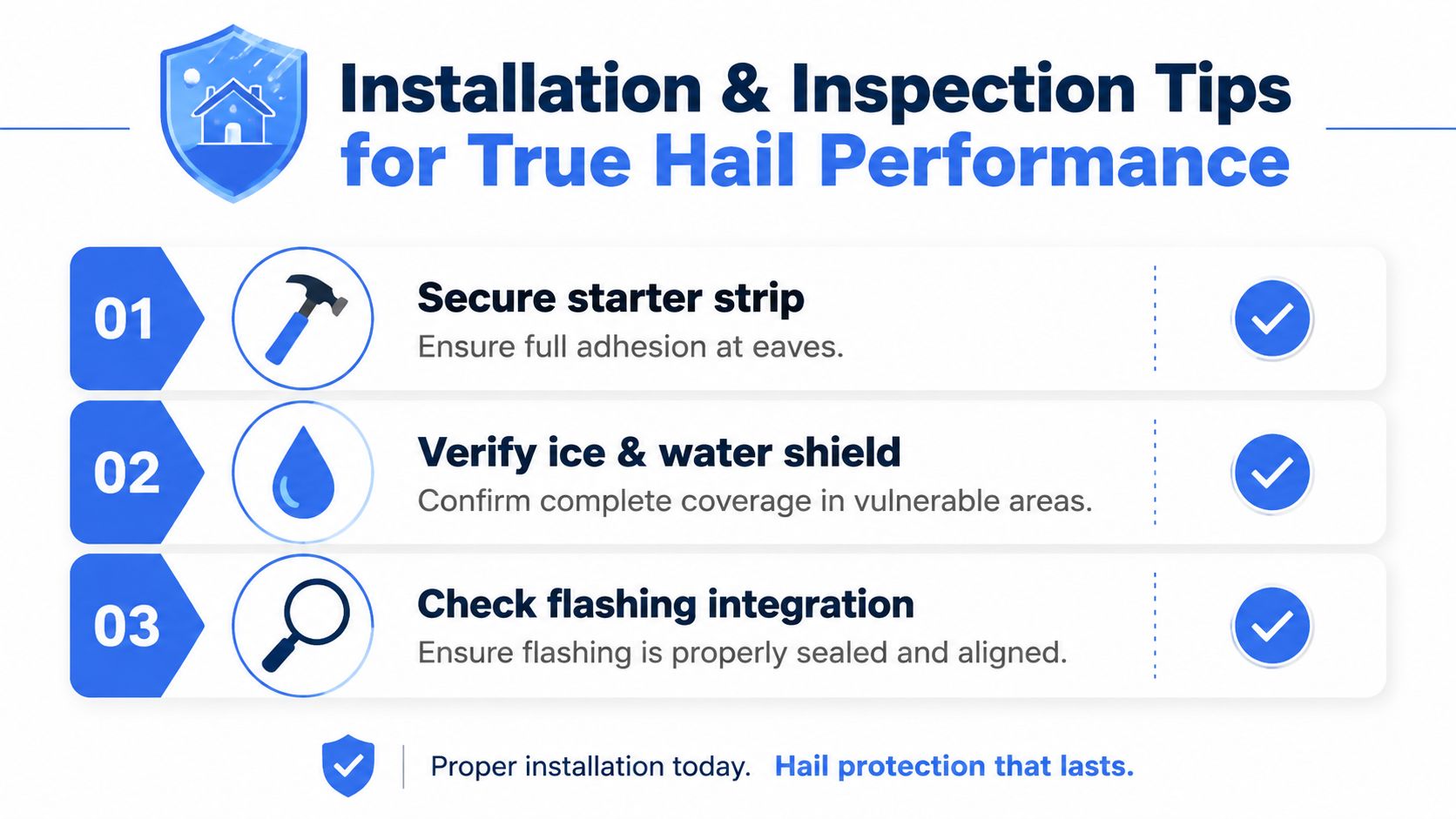
Start at the eaves. The starter strip needs secure placement and full adhesion where the design calls for it. In valleys, confirm that the installer uses the specified ice and water protection. Synthetic underlayment should cover the deck according to the roofing system's instructions, with particular attention to laps and transitions.
Check fastening next. The required fastener pattern depends on the product and local wind requirements, so the contractor should identify that pattern in writing rather than relying on a casual promise. Nail depth and angle matter as much as nail count. A fastener that sits too high can interfere with the shingle above, while an overdriven nail can weaken the material around the head.
Details that deserve a close look
- Flashing integration: Chimneys, vents, sidewalls, and skylights need flashing that works with the new roof, not patches layered over failed components.
- Ridge and hip protection: Use compatible ridge caps and hip shingles when the system requires them. A roof shouldn't have a stronger field shingle with vulnerable edge components.
- Ventilation balance: Intake and ridge ventilation help manage heat and moisture cycling. Poor airflow can contribute to deterioration over time.
- Cold-weather sealing: Don't rely on hand-sealing as a substitute for correct installation conditions and manufacturer requirements.
Red flags include reusing deteriorated flashing, skipping the starter course, leaving valleys underprotected, and describing the project as a “Class 4 upgrade” without discussing underlayment or ventilation. After installation, keep the product wrapper, certification, invoice, warranty documents, permit information, final photographs, and written scope.
Those records support future insurance verification and give the next inspector a clear history of the roof. They also make it easier to distinguish storm damage from pre-existing wear.
Choosing the Right Time to Upgrade and Getting a Free Inspection
The right time to consider hail resistant shingles usually appears through a combination of conditions. An aging roof nearing the last part of its expected service life may justify upgrading during planned replacement. A recent storm with confirmed hail exposure in your ZIP code can justify an inspection before small damage becomes a leak. An insurer's non-renewal notice that cites roof age is another reason to investigate options early.
Start with a ground-level check, but don't climb onto the roof unless you have the proper training and equipment. Look for granule accumulation in gutters, bruising on the south- and west-facing slopes, lifted tabs, damaged vents, and soft spots that a qualified inspector can evaluate. Photograph suspicious areas, record the storm date, and avoid making repairs that could disturb evidence before an insurance inspection.
A useful decision checklist looks like this:
- Roof condition: Is the existing roof already showing age, granule loss, curling, or soft areas?
- Storm exposure: Did a recent event affect nearby properties or leave visible impact marks?
- System scope: Does the estimate include starter, underlayment, flashing, ventilation, ridge caps, and documentation?
- Insurance fit: Has the carrier confirmed how it recognizes the proposed rating?
- Timing: Can the replacement be planned before the next storm season or coordinated with another exterior project?
HIBCO ROOF LLC offers free Columbus-area inspections, documents current roof conditions, reviews upgrade scenarios for the specific property, and helps homeowners plan repair or replacement timing. A no-cost inspection won't turn a Class 4 product into a guarantee, but it can show whether the house needs a complete system decision or only a targeted repair.
If you want a practical assessment of your roof's hail exposure, contact HIBCO ROOF LLC for a free Columbus-area inspection and written estimate. Visit HIBCO ROOF LLC to discuss Class 4 options, system components, storm documentation, and a replacement plan suited to your home.