A Central Ohio homeowner usually sees the shingle color first, then the total replacement price. The underlayment sits out of sight, so the choice between synthetic underlayment and felt paper can look like a minor line item. On a real roof, it affects how the deck handles rain during installation, how the crew moves across the slope, and how much exposure risk remains if a storm interrupts the schedule.
I've installed both materials across Columbus-area homes, including straightforward subdivision reroofs and complicated roofs with valleys, dormers, wall intersections, and multiple penetrations. Synthetic is the practical default for many full replacements, but felt still earns its place when the roof is simple, the weather window is reliable, and the assembly benefits from greater vapor permeability. The right decision isn't based on marketing alone. It's based on what can go wrong before the shingles are installed and whether the added material cost reduces that risk.
Table of Contents
- How to Decide Between Synthetic and Felt on a Real Roof
- What Synthetic Underlayment and Felt Paper Are
- Performance Compared Side by Side
- Cost and What You're Really Paying For
- Installation Differences That Show Up on Job Day
- Code, Fire Ratings, and Warranty Implications
- Which Option Fits Your Columbus-Area Roof
- Questions Columbus Homeowners Ask Before Choosing
How to Decide Between Synthetic and Felt on a Real Roof
At a Central Ohio job walk, a homeowner compared #30 felt with a synthetic roll sized for the project. The bid difference was roughly $400. The practical question was simple: if shingles would cover both products, would the polymer sheet reduce enough project risk to justify the added cost?
On a roof with intersecting slopes, the answer depends on what happens before shingle installation. Tear-off may expose the deck longer than planned. A summer storm can drive water beneath a torn or wrinkled sheet. Steep sections can make damaged material harder and less safe to replace. A product that does not meet the roofing manufacturer's installation requirements can also create a warranty problem before the roof is complete.
Practical rule: Compare the underlayment premium with the risks it controls, not with the price of another roll.
For Columbus-area projects, short-term deck protection matters because crews work around changing weather, wet decking, and scheduling gaps. Synthetic sheets generally handle movement and exposure better. Felt remains a sensible choice when the crew can tear off, dry in, and shingle without leaving the deck open for an extended period.
The material cannot correct poor flashing, missing eave protection, or careless fastening.
My decision process covers seven points:
- Exposure window: How long might the deck remain covered but unshingled?
- Roof complexity: Does the roof include valleys, dormers, penetrations, or multiple transitions?
- Pitch and footing: Will installers work on a demanding 6/12 or 8/12 slope?
- Weather timing: Is the project scheduled during a stable dry spell or an unpredictable season?
- Drying potential: Would the assembly benefit from greater vapor permeability?
- Code and warranty fit: Does the selected product satisfy the required roofing system?
- Total project risk: Will the premium reduce rework, weather exposure, or handling problems?
Synthetic earns its price when exposure, storm timing, roof complexity, or crew movement creates meaningful failure risk. Felt can be the smarter pick for a simple roof, a dependable weather window, and a crew ready to complete the covering without delay. The roof and workflow determine the answer, not a universal product ranking.
What Synthetic Underlayment and Felt Paper Are
Underlayment is the secondary water-shedding layer installed over an OSB or plank roof deck and beneath shingles or another roof covering. It protects the deck during installation and provides backup protection if wind-driven rain reaches beneath the finished roofing. It does not replace shingles, flashing, or properly installed ice and water protection.
Felt paper, also called asphalt-saturated felt or tar paper, consists of an organic or fiberglass mat saturated with asphalt. Traditional felt has roots in the early 1900s, while synthetic underlayment emerged later as a polymer-based alternative, as described in this industry history of felt and synthetic roof underlayment. Contractors often identify felt by nominal weight, such as #15 or #30, but current product labeling and applicable standards provide a more reliable description.
The felt standards homeowners are most likely to encounter are ASTM D226 and ASTM D4869. ASTM D226 covers asphalt-saturated organic felt for roofing and waterproofing. ASTM D4869 addresses asphalt-saturated organic felt underlayment for steep-slope roofing, as explained by the Asphalt Roofing Manufacturers Association. Product specifications still require review because “felt” does not describe one uniform material.
How polymer sheets changed roof installation
Synthetic underlayment generally uses woven or spun-bonded polypropylene, polyethylene, or a similar polymer fabric. Manufacturers design these sheets to remain thin, dimensionally stable, and moisture-resistant, with greater tear resistance than conventional felt. Crews can often move and position the rolls more easily, although weight and handling vary by product.
Felt served as the standard roofing underlayment for decades before synthetic products became a mainstream alternative. Early synthetic products were often evaluated with felt-based testing, even though those methods did not fully reflect polymer membrane behavior. ASTM D8257 in 2021 established a standard specifically for mechanically attached polymeric roof underlayment used in steep-slope roofing, according to this industry explanation of the ASTM standard.
The practical distinction is direct. Felt is an asphaltic sheet with a long installation history. Synthetic is a polymer membrane built around different handling and performance priorities. For the broader roof assembly, review this guide to what goes beneath roof shingles.
Performance Compared Side by Side
The material differences show up most clearly when a roof is exposed to rain, foot traffic, sunlight, or scheduling delays. The table below focuses on the characteristics an installer can observe, while keeping the comparison tied to published specifications and technical summaries.
Synthetic Underlayment vs Felt Paper Performance Snapshot
| Attribute | Synthetic Underlayment | Felt Paper (#30) |
|---|---|---|
| Water resistance | Sheds liquid water and generally absorbs little moisture. Product testing under ASTM D8257 can include hydrostatic resistance and water transmission. | Asphalt-saturated felt can wick and saturate as exposure continues. ASTM D226 and ASTM D4869 govern felt products rather than polymer sheets. |
| Tear strength | Technical summaries report tear-strength differences on the order of 3–5 times versus #30 felt, depending on product and test method. See this technical comparison of metal-roof underlayment. | More vulnerable to tearing around fasteners, penetrations, and foot traffic, particularly after moisture exposure. |
| UV exposure tolerance | Field and product guidance commonly describes roughly 90–180 days for synthetic products, although the wrapper rating controls. | Practical field tolerance is often about 7–14 days before exposure becomes a serious concern. |
| Vapor permeability | Varies widely. Independent summaries cite breathable synthetics around 16–50 perms, while some products test below 0.1 perms and act as near-vapor barriers. | #30 felt is commonly reported around 5–6 perms, making it more vapor-permeable than many synthetic sheets. |
| Weight per square | A roll may cover multiple squares while remaining easy to handle. The product's listed dimensions and weight should be checked rather than assumed. | Heavier felt grades can be cumbersome, and wet material becomes harder to manage. |
| Walkability | Textured products can offer dependable traction, but cold or wet synthetic can still feel slick. | Dry felt often grips naturally, but damp felt can become slippery and may tear under pressure. |
The numbers don't create a universal winner. A long UV window matters if a weather delay leaves the deck covered while the crew waits to return. It matters far less on a simple roof that gets shingled immediately after dry-in.
Where the difference becomes visible
Synthetic usually maintains a more consistent surface after rain because it doesn't absorb water in the same way felt does. Felt can wrinkle, soften, and pull away from a straight chalk line after it gets wet. Those changes make shingle layout and fastening less predictable.
Vapor behavior deserves equal attention. A low-permeance synthetic may protect against liquid water while limiting outward drying. Felt can provide more drying potential, which may help in an assembly with existing moisture concerns, poor attic ventilation, or a design where vapor movement needs careful consideration. The product isn't the only control, but it can influence how the roof assembly manages moisture.
Cost and What You're Really Paying For
Synthetic underlayment generally costs more than #30 felt, and the premium can exceed twice the felt cost in some comparisons, according to the Green Building Advisor technical discussion. That doesn't mean synthetic automatically saves money. The return depends on how much risk the project carries between tear-off and shingle installation.
A typical Columbus reroof can move quickly on a straightforward house, but the deck may still be exposed during tear-off, inspection, repairs, dry-in, and material staging. If rain arrives after felt has absorbed moisture or caused wrinkles, the crew may need to replace damaged sections or wait for the deck and underlayment to stabilize. Synthetic usually buys more tolerance for that sequence, but it still requires proper fastening and correct installation.
Cost Comparison for a Typical Columbus Reroof
| Cost Factor | 30# Felt Paper | Synthetic Underlayment |
|---|---|---|
| Material price | Lower upfront material cost. | Higher upfront material cost, sometimes more than twice the cost of #30 felt. |
| Waste exposure | Wrinkling, tearing, and wet damage can increase replacement waste. | Better resistance to handling damage can reduce waste, depending on the product and crew. |
| Fasteners | Staple or cap-fastener requirements depend on the product and local installation practice. | Manufacturer instructions may specify cap nails or approved fasteners, particularly where wind exposure matters. |
| Labor effect | Works efficiently on a dry, simple roof with a short installation window. | Easier handling and longer exposure tolerance may help when the roof is complex or weather interrupts work. |
| Delay risk | A poor match for prolonged exposure after rain or scheduling disruption. | More forgiving during delays, but the printed exposure rating still controls. |
| Value | Often earns its price on a small, fast repair or tightly scheduled reroof. | Earns its premium when exposure, roof complexity, handling, or weather uncertainty creates meaningful rework risk. |
The cheapest roll can become the expensive choice if a summer storm causes blow-off, if wet felt needs replacement, or if a crew has to return to correct coverage at valleys and penetrations. Those costs don't appear on the material invoice. They appear as labor, schedule disruption, interior protection, and homeowner stress.
Synthetic offers little financial advantage on a simple, dry-weather reroof completed without interruption. If the deck is sound, the roof has few transitions, and shingles follow promptly, #30 felt may perform adequately when installed according to the applicable requirements. Ask for the material, fastening method, exposure rating, and warranty terms in writing before comparing bids.
Installation Differences That Show Up on Job Day
A homeowner can learn a lot by watching the first few courses go down. The crew should begin with a clean, dry deck, repair damaged sheathing, and establish straight reference lines. Underlayment should lie flat, with laps and penetrations handled according to the product instructions rather than improvised around obstacles.
Felt usually comes off the roll with more memory and can develop wrinkles if the deck is damp or the sheet isn't pulled tight. Synthetic tends to lay flatter and remain dimensionally stable, but a cold or wet surface can still be slippery. Textured printing helps some products, yet no underlayment turns a steep roof into a safe walking surface.
Fastening and layout
Look for consistent fastening rather than random staples scattered across the sheet. Some synthetic products require cap nails or specific fastener spacing, while felt installation may use staples or cap fasteners based on the product and local requirements. The installer should follow the wrapper and shingle manufacturer's instructions, especially around laps, hips, ridges, valleys, walls, and penetrations.
On a 6/12 or 8/12 Columbus roof, the difference between dry and wet footing is obvious. A crew that has to fight slippery material may work more slowly or take shortcuts. Proper roof access, fall protection, and deliberate movement matter more than whether the surface is labeled premium.
For ice-dam protection at eaves and vulnerable transitions, homeowners should understand that sheet underlayment isn't interchangeable with a self-adhered membrane. The ice and water shield installation guide shows why those areas need a specifically selected and properly integrated product.
Signs of careful work
- Flat courses: Wrinkles, fishmouths, and loose edges should be corrected before shingles cover them.
- Straight overlaps: Laps should follow the manufacturer's required direction and alignment.
- Protected valleys: Valley coverage should remain continuous, without exposed deck gaps or careless cuts.
- Sealed penetrations: Pipes, walls, and roof transitions need compatible flashing and underlayment detailing.
- Clean edges: Eaves and rakes should be prepared so water drains onto the intended flashing or starter system.
Code, Fire Ratings, and Warranty Implications
Code compliance depends on the complete roof setup, not whether the roll is felt or synthetic. The residential code, roof covering, slope, climate exposure, eave protection, fastening, and manufacturer instructions must work together. Before work starts, the contractor and building department should resolve questions about unusual assemblies or partial reroofs.
ASTM D226 and ASTM D4869 apply to asphalt-saturated felt products. Synthetic underlayment has often been compared with felt standards that were not written specifically for polymer sheets. The National Roofing Contractors Association discusses the limited history of standards written for synthetic sheet underlayments and explains why product documentation matters. Its roofing guidelines on synthetic sheet underlayments provide useful trade context.
ASTM D8257 provides a more specific framework for mechanically attached polymeric underlayment. The standard addresses fastener pull-through, UV resistance, hydrostatic resistance, tear resistance, vapor transmission, accelerated weathering, and dimensional stability, as summarized in this ASTM synthetic underlayment data sheet.
Fire ratings are assembly questions
A Class A shingle label does not by itself establish the fire performance of the entire roof. The shingles, underlayment, deck, attachment method, slope, and tested system can all affect the result. For a closer look at Class A fire rating requirements, review how the roof covering and supporting materials are evaluated together. Fire-code guidance also explains why Class A shingle requirements can involve more than the shingle alone.
Ask whether the proposed shingle and underlayment combination is an approved assembly for the project. A contractor should not promise a fire rating based only on the label printed on the shingle package.
Warranty language deserves a close read
Manufacturers may require a particular underlayment, eave protection product, or installation method as part of their system instructions. Felt substituted for a specified synthetic product, or the reverse, can conflict with those written requirements and affect warranty coverage. The same applies to ice-dam protection and other areas governed by the applicable residential code, including provisions associated with IRC R905.
Put the exact product names on the estimate. Warranty protection depends on installing the documented system, not merely a similar-looking roll.
Which Option Fits Your Columbus-Area Roof
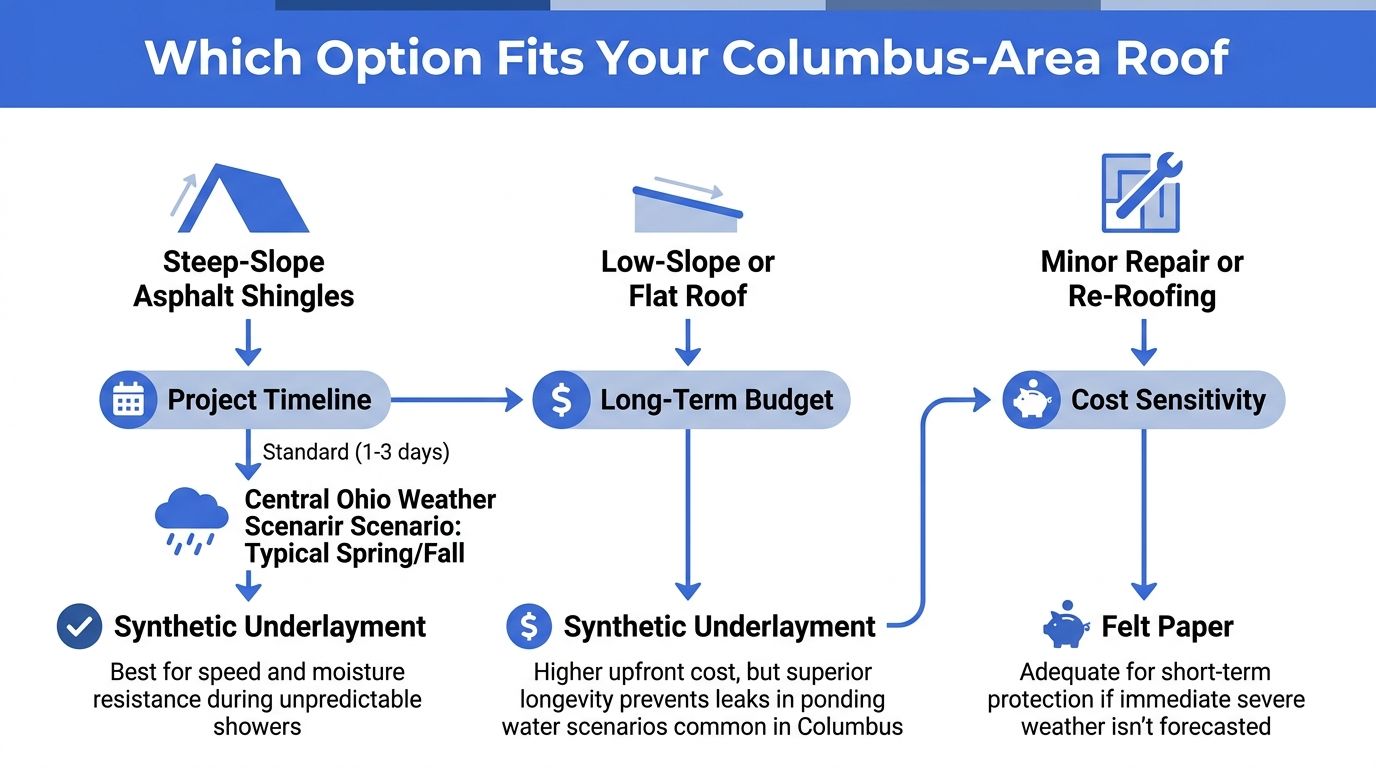
For a typical steep-slope asphalt shingle replacement in a Columbus subdivision, I generally lean toward synthetic. Roofs with several planes, valleys, dormers, and wall intersections benefit from a sheet that handles movement and jobsite traffic without absorbing rain as readily. The longer exposure window described in technical guidance also gives the crew more flexibility when Central Ohio weather disrupts the schedule.
That recommendation changes for metal roofing. A high-temperature synthetic product may be appropriate beneath metal panels, but the panel manufacturer can require a specific membrane or felt grade to manage heat, friction, and chemical compatibility. Never assume the synthetic used under asphalt shingles is suitable beneath standing-seam metal. The roof covering's installation manual controls.
Low-slope sections require more caution. Porches, additions, and dormers near 3:12 may need a different underlayment strategy, including self-adhered membranes or specially layered protection, depending on the roof covering and Ohio code requirements. A contractor should identify each low-slope area on the estimate rather than treating the entire roof as one uniform surface.
When felt still makes sense
#30 felt can be the smarter pick when the project has a short, predictable dry-in window and the roof is simple. It can also suit a small repair where replacing a limited section with a compatible traditional material avoids unnecessary cost and complexity. Historic homes may present another case, especially when the roofer is intentionally preserving a more vapor-permeable assembly.
Synthetic earns its price when the project carries more exposure or handling risk. That includes complicated roof geometry, uncertain weather, cold-season work, metal-roof requirements, or a schedule where the deck may remain covered but unshingled longer than planned.
Use this decision rule during contract review:
- Simple roof, immediate shingling, strict budget: Ask whether #30 felt meets the code and roofing manufacturer's written requirements.
- Complex roof, weather uncertainty, or delay risk: Choose a synthetic product with a documented exposure rating and installation method.
- Low-slope or metal sections: Select the material specified for that roof covering and slope, which may not be the same product used on the main shingle field.
- Existing moisture or ventilation concerns: Have the contractor evaluate vapor permeability and the full assembly before selecting a low-permeance synthetic.
The best material is the one that fits the roof system, not the one with the loudest sales pitch.
Questions Columbus Homeowners Ask Before Choosing
Will insurance pay for a synthetic upgrade after storm damage? Usually, the answer depends on the policy, the documented scope, local requirements, and whether the upgrade is necessary to restore the roof to current code or manufacturer requirements. Ask the contractor to list the existing and proposed underlayment separately, identify any required upgrade, and provide product documentation so the carrier can evaluate the line item rather than automatically comparing it with basic felt.
What happens if rain delays shingle installation beyond the exposure rating? The contractor should protect the roof, inspect the membrane, and follow the product manufacturer's instructions. If the material has degraded, torn, or lost required performance, the responsible party should address replacement before shingles cover it. Put the exposure limit, weather-response plan, and responsibility for resulting interior damage in the contract.
Can synthetic and felt be mixed on one roof? A partial reroof can contain different materials, but the transition must satisfy the applicable code, shingle instructions, and local inspection expectations. Franklin County and Delaware County inspectors may evaluate the project based on the adopted requirements and scope, so don't rely on a verbal assumption. Ask the contractor to document where each material begins and ends.
Does the workmanship warranty change with the material? It can. The written warranty should state whether coverage applies to installation only, material defects, leak response, or specific components. Shingle manufacturers may also require particular underlayment products or installation methods for their system warranty.
How can I verify what was installed? Check the wrapper labels left at the curb or saved with the project records. Photograph the product name, ASTM designation, exposure rating, and lot information before the rolls disappear. Also request progress photos showing eaves, valleys, wall intersections, and penetrations before shingles conceal the work.
A roof estimate that names only “underlayment” leaves too much unanswered. The document should identify the material, fastening method, exposure limits, special membranes, and warranty relationship.
HIBCO ROOF LLC provides roof inspections, repairs, storm-damage documentation, and full roof replacements for Columbus and Central Ohio homeowners, with the underlayment and other roof-system components identified in the written scope. Visit HIBCO ROOF LLC to request a free estimate and discuss whether synthetic or felt fits your roof, schedule, and weather exposure.