
For a typical U.S. home in 2026, a full asphalt-shingle roof replacement commonly lands between $7,500 and $30,000, with many projects near $9,000 to $18,000. Modernize's 2026 roofing cost guide provides that national budgeting range, but the number on your estimate depends on what the contractor must remove, repair, install, and protect.
You may be looking at two quotes on your kitchen counter right now. Both may say “full asphalt-shingle roof replacement,” yet one is thousands higher than the other. The lower figure feels attractive, especially when the roof already represents a major household expense. But a roof estimate behaves more like a recipe than a menu price. If one contractor includes the waterproofing layers, flashing, ventilation, cleanup, and damaged decking, while another leaves them out, the totals aren't describing the same meal.
The phrase cost roof house sounds like a simple pricing question. In practice, it's a question about roof area, labor difficulty, material grade, hidden conditions, and the exact scope written into the contract. This guide follows those line items in the same order an experienced roofing project manager reviews them, so you can compare estimates by substance instead of by the largest number at the bottom.
Table of Contents
- Why Two Roof Quotes Can Differ by Thousands
- How Roofers Measure and Price a Roof
- What Is Inside a Roofing Estimate
- The Hidden Factors That Drive Cost Up
- Realistic 2026 Price Ranges by Home Size
- Insurance, Deductibles, and Financing Options
- How to Get an Accurate Written Estimate
- Making a Confident Roofing Decision
Why Two Roof Quotes Can Differ by Thousands
A homeowner named Mark recently received two written estimates for what appeared to be the same asphalt-shingle replacement. Both contractors measured the house, listed new shingles, and promised cleanup. One quote was roughly $7,000 higher than the other. Mark's first reaction was predictable: choose the cheaper contractor and keep the difference.
A closer reading changed the picture. The lower quote used a basic shingle grade, allowed minimal underlayment, and said “repair flashing as needed.” It didn't clearly mention starter strips, ridge cap, ventilation, or disposal. The higher estimate specified the shingle product, synthetic underlayment, ice and water protection, new step flashing where needed, ridge ventilation, replacement of deteriorated deck boards, and haul-away of tear-off waste.
Neither price was automatically right or wrong. They were different scopes.
The line items behind the gap
Shingle grade affects appearance, warranty terms, and material cost. A three-tab product and an architectural product shouldn't be compared as if they're interchangeable. The Roofing Calculator 2026 pricing guide places installed asphalt-shingle pricing around $3.40 to $5.95 per square foot, with three-tab shingles around $3.43 to $4.65 and architectural shingles around $4.11 to $5.57.
Underlayment is the protective layer beneath the shingles. Flashing directs water around chimneys, walls, skylights, and roof transitions. Starter strip seals the first course, while ridge cap protects the roof's highest seams. If a quote skips these words, ask whether the work is excluded or folded into a vague allowance.
Ventilation upgrades, deck repairs, tear-off, and disposal create another major divide. A contractor who expects to inspect the deck only after removing the old shingles may include a transparent “per sheet as needed” allowance. Another may leave the possibility unmentioned, creating a lower starting price and a higher change-order risk.
Practical rule: A low total isn't a bargain until you know whether both contractors priced the same roof system.
An itemized estimate exposes the math. A round number hides it. Before signing, compare the product, number of layers, tear-off method, underlayment, flashing, ventilation, deck repair policy, permits, warranty, and cleanup. The rest of this guide teaches you to read those details line by line, so quiet variables don't inflate your bottom line after the crew arrives.
How Roofers Measure and Price a Roof
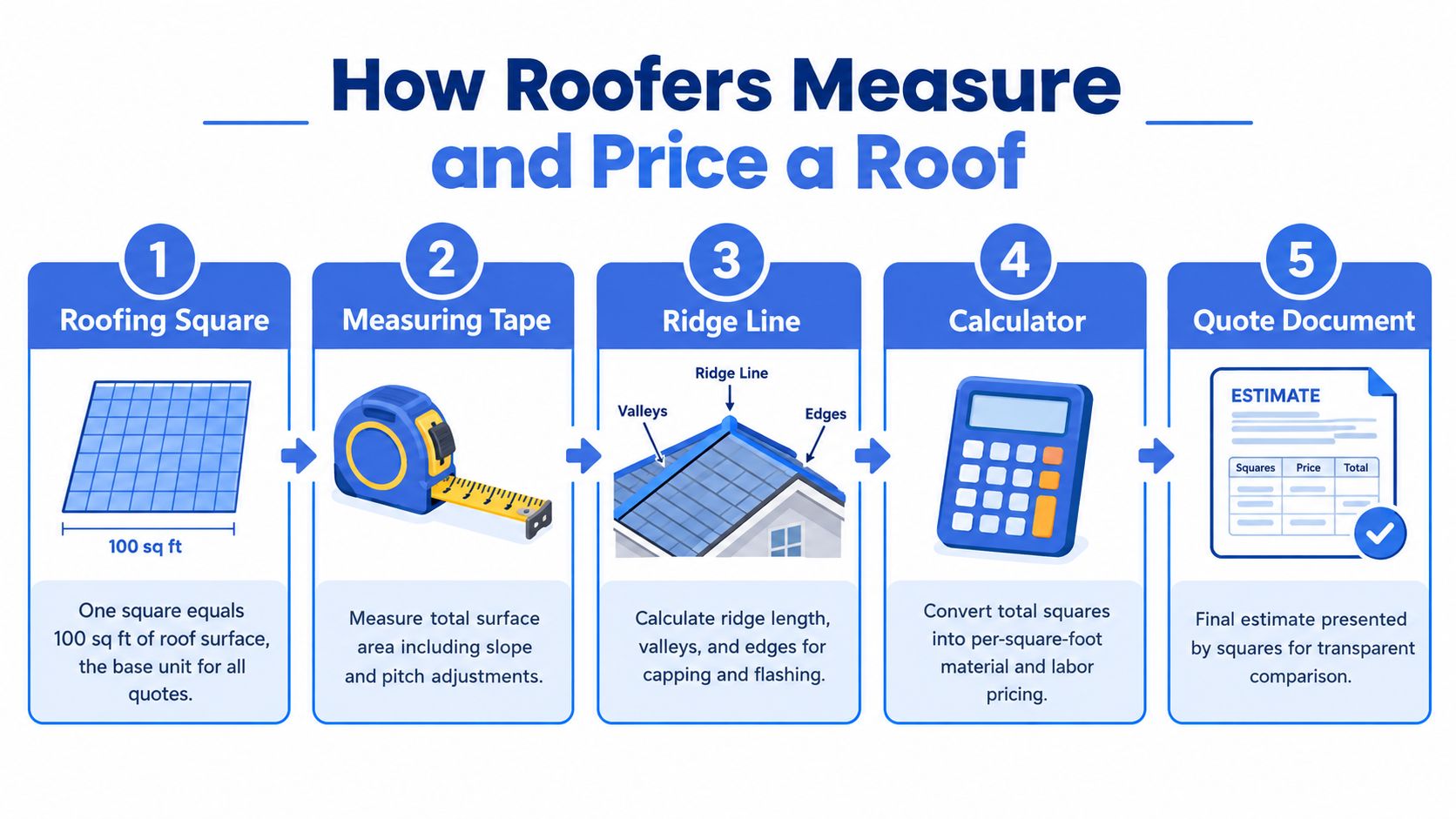
A roofer does not price a house by counting bedrooms or measuring the living room. The estimate starts with the roof surface, because that is what the crew will cover, remove, protect, and finish. The standard unit is a roofing square, equal to 100 square feet of roof surface. Shingles, underlayment, ridge materials, and labor are often ordered or priced by this unit.
The measurement process
The estimator begins with the building's horizontal footprint, then adjusts the calculation for slope and pitch. A steep roof has more actual surface than a low-slope roof covering the same footprint. The measurement also includes ridge length, hip lines, valleys, eaves, rakes, and penetrations. Each feature affects the quantities of field shingles, caps, flashing, and edge protection.
Waste is part of the installation plan, not automatically careless spending. Crews cut shingles around valleys, hips, dormers, walls, and vents. The estimator includes an allowance so the crew can follow those patterns without running short. A roof with several angles usually creates more cuts and off-cuts than a simple gable roof.
For a 2,000-square-foot single-story home with a moderate pitch, the roof surface may measure about 2,400 to 2,700 square feet, or roughly 24 to 27 squares. The sloped planes extend beyond the floor footprint, much like fabric needs extra material to cover a shaped object rather than a flat box. Berkeley Exteriors explains the same roof-area principle, including how hips, dormers, valleys, and pitch affect the final square count.
A quick sanity check
Installed asphalt roofing commonly runs about $350 to $1,600 per square, depending on the product and project conditions. That broad range cannot replace a site inspection, but it gives you a way to question a lump-sum quote. A price guide for a new roof per square foot can provide another comparison point.
A measured roof of 25 squares should appear in the conversation as 25 squares, not only as “a 2,000-square-foot house.” Ask whether the square count includes waste and whether the price covers tear-off, disposal, underlayment, flashing, ventilation, and permits. Read the estimate line by line. Unit price explains one part of the bill, while the written scope shows which work is included.
What Is Inside a Roofing Estimate
A roofing estimate should read like a sequence of work, not a mysterious total. The crew removes the existing covering, prepares the deck, installs water-shedding layers, places the shingles, finishes edges and penetrations, and cleans the property. Reading the quote line by line helps you see which tasks and materials are included.
The following planning shares are approximate editorial budgeting ranges, not fixed industry prices. They show how a typical asphalt-shingle replacement may allocate money. Your home's pitch, access, condition, and local requirements determine the actual total.
| Line Item | Share of Total Cost |
|---|---|
| Labor, tear-off, installation, and cleanup | 35% to 40% |
| Shingles and ridge cap | 30% to 35% |
| Underlayment, ice and water shield, and starter strip | 8% to 12% |
| Flashing, drip edge, and ventilation components | 5% to 8% |
| Disposal and dump fees | 3% to 5% |
| Overhead, permits, and warranty administration | 5% to 10% |
Labor is more than nailing shingles
The labor line covers setup, protection for siding and landscaping, tear-off, material handling, installation, detailing, magnetic cleanup, and final inspection. A steep roof or difficult delivery path can lengthen the job even when the roof has a modest square count. The quote should make clear whether cleanup and protection are included or treated as separate work.
Shingles and ridge cap are the visible materials, but they form only part of the roofing system. The NerdWallet roof replacement cost explanation places installed residential asphalt replacement around $3.50 to $6.00 per square foot, while broader installed ranges can reach about $4 to $11 per square foot as material grade, labor, disposal, pitch, and access change. Use those figures as comparison points, not as a substitute for a measured scope.
The layers that prevent future trouble
Underlayment creates a secondary water barrier below the shingles. Ice and water shield protects vulnerable areas such as eaves and valleys where local code or roof design calls for it. Starter strip and ridge cap finish locations where standard field shingles are not the right component.
Flashing and drip edge direct water at transitions and boundaries. Ventilation helps manage attic moisture and heat. Removing these components from a quote can lower the initial total while leaving out work needed for a complete roof system. Ask for the product and location of each layer, not just a general “roofing materials” allowance.
Waste, permits, and the contractor's operating cost
Tear-off debris must be loaded, transported, and processed. A separate disposal allowance should state whether it covers the expected number of existing layers and how additional debris will be priced. This line can change the final bill when the roof contains more material than the initial inspection suggested.
Permits, supervision, insurance, warranty administration, and business overhead also belong in a legitimate estimate. Homeowners comparing renovation budgets can use this guide to renovation cost planning for hard money loans when a roof forms part of a larger property project. Compare bids by matching their line items and assumptions. A lower total may leave disposal, permits, or warranty administration outside the written scope.
The Hidden Factors That Drive Cost Up
The shingles often get blamed when estimates diverge, but roof conditions usually create the larger surprise. A steep roof slows every task. A second shingle layer adds another removal cycle. A soft section of decking can't be priced accurately until the old roof is opened.
What the crew discovers during tear-off
Roof pitch affects safety equipment, staging, walking speed, and material movement. The crew may need additional fall protection or more careful hand-carrying, especially on a multi-level home.
Existing layers affect both labor and disposal. If local rules and the deck condition require a full tear-off, every layer must be removed and hauled away. An estimate should say how many layers the contractor expects and how additional layers will be priced if inspection reveals more.
Decking condition is the classic hidden condition. Water entering around a failed flashing point can soften plywood or roof sheathing. The contractor can identify suspicious areas from the attic or exterior, but complete confirmation often requires tear-off. Ask whether damaged decking is charged per sheet, by area, or through a stated allowance.
The roof details that demand custom work
Skylights, chimneys, wall intersections, dormers, and dead valleys need careful flashing. A roof with many penetrations may contain fewer field shingles than a simple roof, yet require more cutting and detail work.
Permits and code requirements vary by jurisdiction. Ice and water protection, drip edge, ventilation, and flashing requirements can change the scope even between neighboring communities. Gutters, chimney repointing, and blocked material access are separate concerns that may appear as optional work or necessary preparation.
| Add-On Factor | Typical Added Cost | What Triggers It |
|---|---|---|
| Steep pitch and difficult staging | Project-specific allowance | Safety equipment, slower movement, complex access |
| Additional shingle layers | Project-specific allowance | More tear-off labor and disposal |
| Decking replacement | Per-sheet or stated allowance | Rot, softness, or water damage exposed during tear-off |
| Permit and code upgrades | Local fee or allowance | Jurisdictional requirements |
| Skylight or chimney flashing | Custom line item | Failed, aged, or complicated flashing |
| Gutter replacement | Separate system price | Damaged, undersized, or incompatible gutters |
| Difficult delivery access | Project-specific allowance | Limited driveway, narrow lot, or long material carry |
These factors explain why two homes with similar floor areas can produce very different quotes. The contractor isn't charging for square footage alone. They're charging for the number of decisions, cuts, safety steps, repairs, and handling tasks needed to make the roof watertight.
Realistic 2026 Price Ranges by Home Size
Home size provides only a starting point. The roof's measured squares, shape, pitch, material grade, and tear-off scope determine the actual price. A compact ranch with a simple gable may cost less than a larger two-story home with hips, valleys, dormers, and difficult access.
The table below is a planning framework for asphalt-shingle replacements. It compares material tiers qualitatively because the verified national guides provide overall ranges and product-specific per-square-foot pricing, but they don't establish reliable national totals for every home size and shingle tier.
| Home Size, Approx. Roof Squares | Builder-Grade Architectural | Mid-Tier Architectural | Premium / Impact-Resistant |
|---|---|---|---|
| 1,500 sq. ft., about 15 to 18 squares | Lower part of the asphalt range, simple roof | Middle of the asphalt range, upgraded warranty features | Upper part of the asphalt range, specialty product |
| 2,000 sq. ft., about 20 to 25 squares | About $8,500 to $14,800 for a typical full replacement | About $10,000 to $16,000 for architectural asphalt | Higher than mid-tier, depending on product and roof complexity |
| 2,500 sq. ft., about 25 to 30 squares | Scales upward with roof area and installation scope | Often near the middle to upper part of the national range | Highest material tier, with the widest project-specific variation |
For the 2,000-square-foot example, Roofing Calculator HQ's 2026 guide places full asphalt replacement around $8,500 to $14,800, with a midpoint near $11,200, while architectural asphalt is estimated around $10,000 to $16,000. Those figures describe a typical project, not a guarantee for a steep or damaged roof.
A useful way to compare the tiers is to ask what the upgrade buys. Builder-grade architectural shingles may suit a straightforward replacement. Mid-tier products may offer improved wind or algae warranty features. Premium or impact-resistant products can make sense where the roof faces severe weather or where an insurer offers a qualifying discount, but the discount and eligibility must be confirmed with the carrier.
Tear-off layers, steep pitch, and moderate decking replacement can move a midpoint upward by 10% to 25%, according to the planning assumptions in this guide. Storm-related decisions deserve separate scrutiny, so homeowners can review this resource on an insurance claim for roof replacement before treating an upgrade as an insurance-funded expense. For another regional comparison, see average roof replacement cost Ohio, while remembering that local scope matters more than a national average.
Insurance, Deductibles, and Financing Options
A storm damages several roof slopes, while the rest of the shingles are worn out. Your estimate may show a covered repair, an uncovered age-related replacement, and your share of the bill as separate items. Reading those lines separately prevents the insurance decision from becoming a guess about one large total.
Insurance generally responds to covered causes such as hail or wind, rather than ordinary aging. The practical question is whether the covered damage exceeds your deductible and whether filing fits your policy history and future coverage concerns.
A fixed deductible is easy to identify. A percentage wind or hail deductible is calculated from the dwelling coverage amount. Storm-prone policies commonly use 1% to 5% of dwelling coverage, as described in JRCousa's hail-damage insurance discussion. With $400,000 in dwelling coverage and a 2% deductible, the homeowner would pay $8,000 before coverage begins.
Compare the estimate with the deductible
A $10,000 roof claim against an $8,000 deductible may leave limited insurance benefit after coverage terms, depreciation, and possible premium consequences are considered. Widespread storm damage that clearly exceeds the deductible presents a different choice from a few damaged shingles or a roof that has reached the end of its service life.
For a storm claim, record the date, visible damage, leaks, temporary protection, and professional inspection findings. Contractors can document conditions and prepare an estimate, but the insurer decides coverage under the policy. A qualified adjuster or public adjuster may help explain disputed scope.
Funding a replacement
Homeowners may compare contractor payment plans, promotional same-as-cash arrangements, home equity lines, or FHA Title I loans. Each option changes the cost through interest, term length, fees, approval requirements, or any lien placed against the property. A low monthly payment can hide a longer repayment period, so read the complete agreement before signing.
Policy wording also affects the timing and amount of payment. Actual cash value generally accounts for depreciation, while replacement cost can reimburse eligible replacement expenses under the policy terms. This actual cash value vs. replacement cost roof explanation can help you identify what to ask your carrier.
Decision rule: Filing usually makes more sense when storm damage is widespread, the repair clearly exceeds the deductible, and the claim does not create an unacceptable renewal risk. Paying out of pocket or financing may be more sensible when damage is isolated, the estimate sits near the deductible, or age rather than a covered event caused the failure.
How to Get an Accurate Written Estimate
Start with an inspection, not a phone price. The contractor should examine the roof surface, attic where accessible, eaves, valleys, penetrations, wall transitions, gutters, and visible deck conditions. Ask how many existing shingle layers are present and whether the crew expects a full tear-off.
Satellite measurements can help an estimator prepare quickly, but they don't show every flashing defect, soft deck area, ventilation problem, or access constraint. The final price should be verified on-site. A contractor who refuses to inspect a complicated roof is asking you to accept uncertainty before the work begins.
Require a complete scope
Your written estimate should identify:
- Tear-off: Number of layers included, protection measures, and disposal method.
- Materials: Shingle brand and product line, underlayment, ice and water shield, starter strip, ridge cap, and ventilation components.
- Flashing: Whether existing flashing stays, receives new metal, or gets replaced around chimneys, skylights, walls, and valleys.
- Decking: Unit price or allowance for damaged sheathing discovered during removal.
- Finishing work: Drip edge, pipe boots, vents, cleanup, magnetic nail sweep, and permit fees.
- Schedule and payment: Start conditions, payment milestones, change-order process, and responsibility for weather delays.
“Install new roof” isn't a scope. It doesn't tell you whether the contractor is removing old materials, replacing flashing, repairing decking, upgrading ventilation, or hauling away the debris.
Verify warranty and contractor documents
Manufacturer coverage and workmanship coverage are different. The manufacturer addresses defects in the roofing product under its terms. The contractor's workmanship warranty addresses installation errors, exclusions, transfer rules, and response procedures. Get both documents in writing before work starts.
Request the contractor's license information where required, certificate of insurance, and local references for comparable projects. Check that the company name on the estimate matches the entity named in the contract and warranty. Ask who will supervise the crew and who handles warranty calls after completion.
Before signing, read every allowance and exclusion. Confirm the final shingle color, ventilation plan, deck-repair price, cleanup promise, permit responsibility, cancellation terms, and payment schedule. A trustworthy estimate doesn't eliminate every uncertainty. It identifies the uncertainty and gives you a fair way to handle it.
Making a Confident Roofing Decision
The right roof decision starts with condition, not the lowest bid. A one-layer roof with sound decking and a simple layout may justify a straightforward asphalt replacement. A roof with multiple layers, active leaks, failed flashing, or widespread soft decking needs a more complete scope, because adding isolated repairs to a failing system can postpone the expense without solving the cause.
Storm damage changes the timing. The claim decision depends on the policy, deductible, documented cause, and repair scope. Don't authorize replacement solely because a salesperson points to a few marks, and don't dismiss a legitimate claim before documenting the conditions.
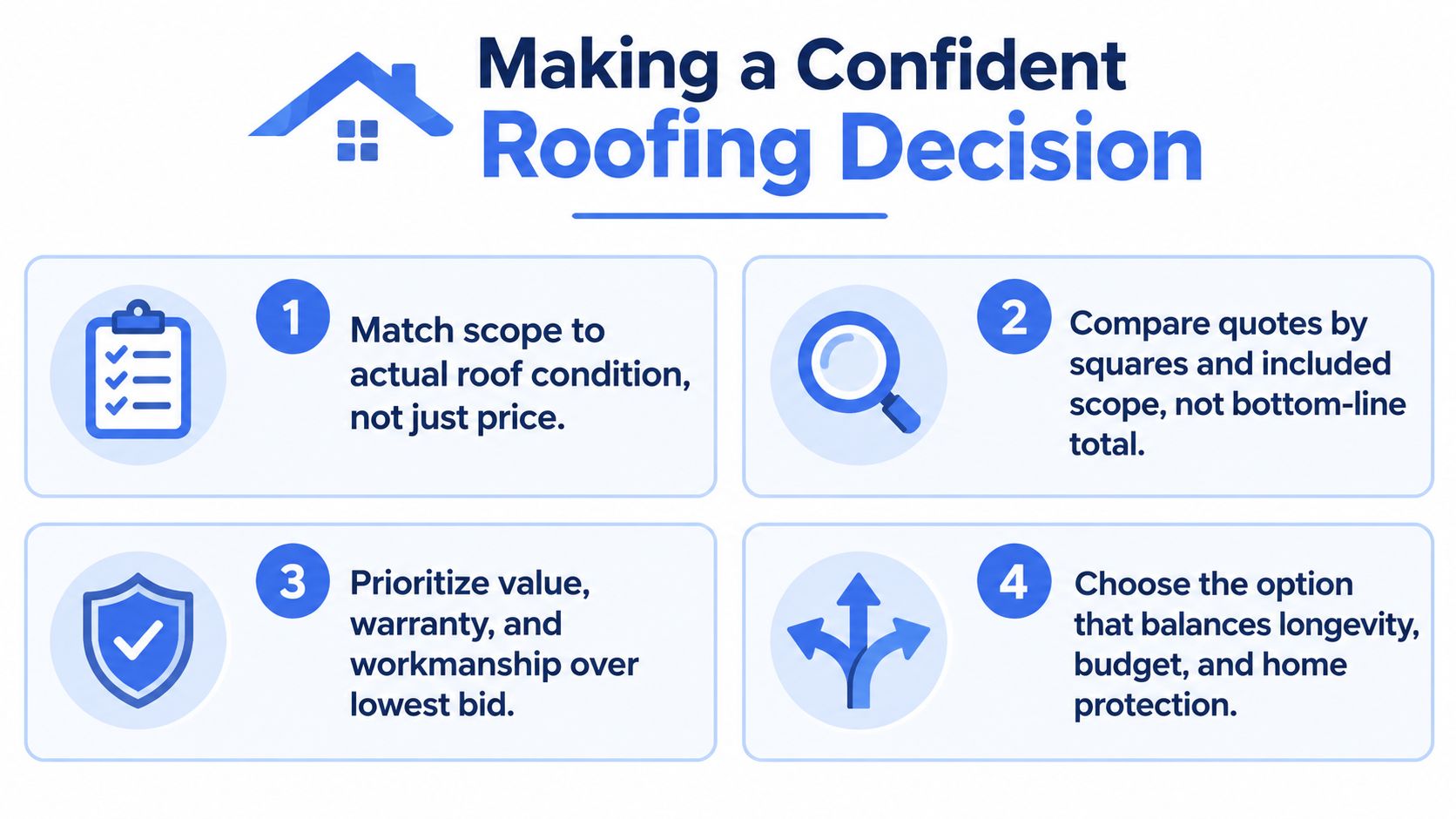
Use the estimate as a decision document. Compare squares, product names, underlayment, flashing, ventilation, deck policy, permits, cleanup, warranty terms, and payment schedule. A contractor serving a different climate or roof style may have useful general information, but a resource about a patio roof contractor Fresno CA isn't a substitute for a local inspection of your home's actual structure.
Avoid same-day signing pressure. Verify insurance, references, contract language, and the company's ability to answer questions in writing. A modest difference in price can be reasonable when it reflects better materials, safer installation, complete flashing, or a clearly defined repair allowance.
The best estimate is the one whose scope matches the home's condition, whose materials are spelled out, and whose contractor will still be available to honor the workmanship warranty years from now.
If you're planning a repair or replacement in Columbus or central Ohio, HIBCO ROOF LLC provides free inspections, no-pressure written estimates, storm-damage documentation, asphalt-shingle replacement, and related gutter and skylight services. Visit HIBCO ROOF LLC to request an inspection and compare your roof's actual condition with a line-item scope before you sign.