Insurance typically pays the replacement cost value minus your deductible, or the actual cash value after depreciation and your deductible. In many RCV claims, you first receive an ACV check, then recoverable depreciation is released after the roof is replaced and properly documented, so the final cash depends on roof age, materials, cause of loss, policy limits, and the deductible.
A Columbus storm can make that distinction feel urgent. You notice shingles in the yard, a ceiling stain, or water entering around a vent, then discover that the first insurance payment may not match the contractor's estimate. The important question isn't whether insurance covers the roof. It's what you receive today, what may arrive later, and which costs remain yours.
Table of Contents
- What Insurance Actually Pays for a Roof Replacement
- How Insurers Calculate Your Payout With ACV and RCV
- Key Factors That Change Your Final Payout Amount
- Sample Payout Calculations You Can Apply to Your Roof
- How to Document Damage and File a Roof Claim Successfully
- Tips to Improve Your Claim Outcome in Columbus
- Getting Your Roof Replacement Covered and Next Steps
What Insurance Actually Pays for a Roof Replacement
After a strong wind or hail event, two Columbus neighbors can have similar-looking damage and receive very different payments. One may have replacement cost coverage, while the other has actual cash value coverage. Their roof ages, deductibles, policy limits, and settlement terms can also differ.
The roof claim has more than one number
Think of the claim as a sequence rather than a single check. The insurer first determines the estimated cost to repair or replace the roof with similar materials. Then it applies the policy's settlement method.
With replacement cost value, or RCV, the insurer generally considers the current replacement cost and subtracts the deductible, without taking depreciation from the covered replacement amount. With actual cash value, or ACV, the insurer subtracts depreciation tied to age and condition, then applies the deductible.
RCV claims often create the most confusion because the first payment may still be calculated using ACV. The carrier can issue the depreciated amount initially and hold back recoverable depreciation until the work is complete. You'll usually need to provide an invoice, completion certificate, or other proof that the roof was replaced.
Practical rule: Treat the first check as a starting payment, not automatically as the full value of an RCV claim.
Why Columbus homeowners should read the policy first
A declarations page can show the dwelling limit, deductible, and relevant coverage terms, but the settlement language and endorsements may appear elsewhere in the policy. Look specifically for RCV, ACV, roof payment schedules, wind or hail deductibles, exclusions, and documentation deadlines.
For broader insurance background, a Washington home insurance guide can help explain how policy structure and coverage terms affect homeowner decisions, even though your Columbus policy controls your claim.
Before agreeing to a replacement scope, identify whether the insurer requires similar materials, whether matching issues affect the estimate, and whether local requirements may change the work. A contractor can document the roof, but only your insurer and policy determine the covered amount.
How Insurers Calculate Your Payout With ACV and RCV
The simplest way to understand ACV and RCV is to compare a new roof with an older roof that has already delivered years of service. RCV focuses on what similar materials cost today. ACV starts with that replacement figure, then reduces it for depreciation.
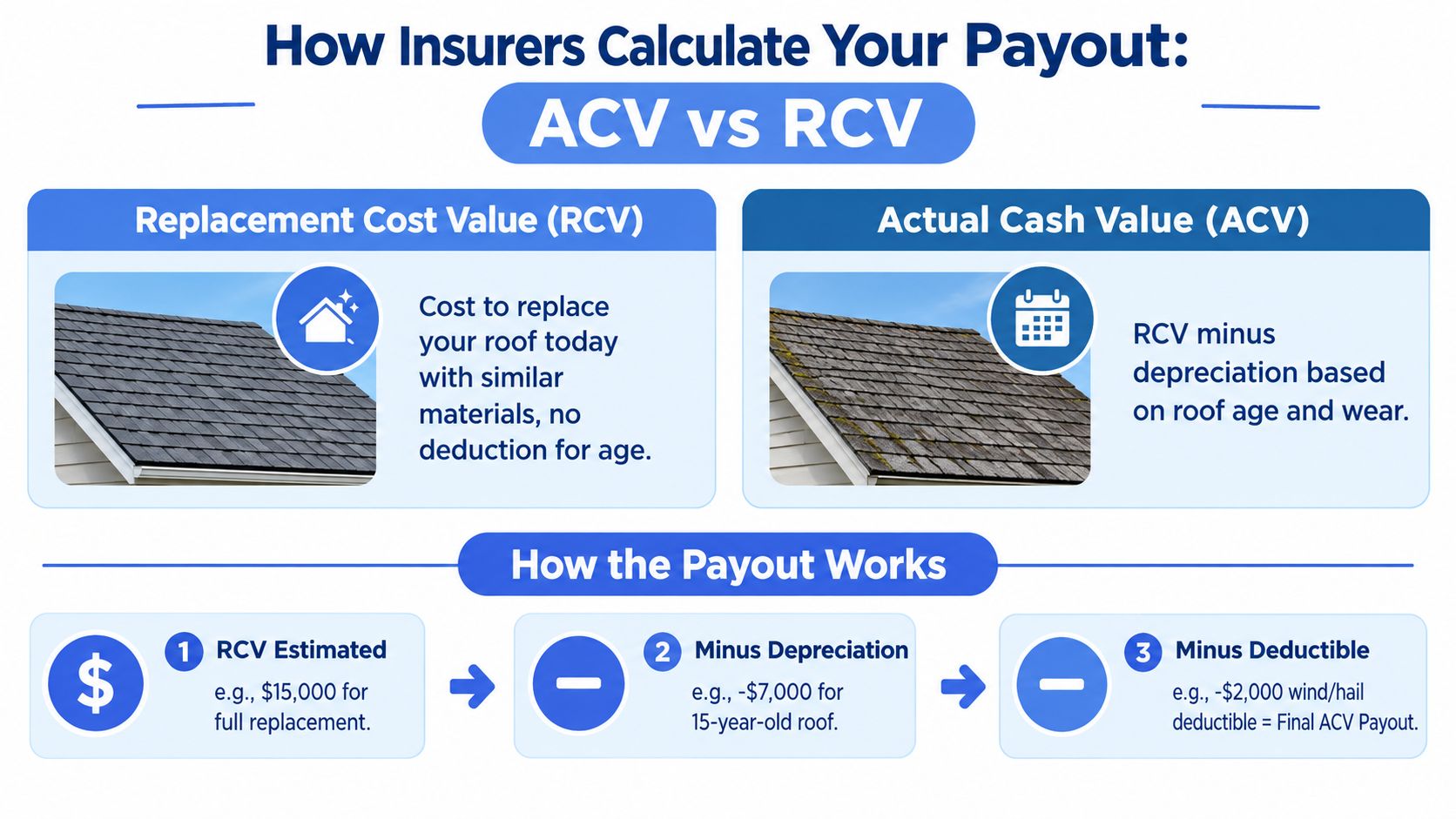
RCV and ACV side by side
Suppose the insurer's approved replacement estimate is $20,000. Under RCV, the covered amount can be paid at the replacement cost, less the deductible. Under ACV, depreciation reduces the amount before the deductible is applied.
An insurer's example shows how this works. A $20,000 roof can be paid in full under RCV, minus the deductible, while ACV may subtract $5,000 for depreciation, leaving $15,000 before the deductible. The example and settlement explanation are described by Amica's roof replacement coverage guide.
| Settlement method | Starting point | Depreciation | Deductible |
|---|---|---|---|
| RCV | Current cost for similar replacement | Usually not deducted from the completed replacement amount | Subtracted |
| ACV | Current replacement cost | Subtracted for age and condition | Subtracted separately |
A new car and a ten-year-old car may have similar transportation purposes, but they don't have the same value. ACV applies a comparable idea to a roof. The insurer may recognize the cost of a comparable replacement while accounting for the roof's consumed service life.
Why the first RCV check can be smaller
Many carriers use a two-step process. The first check reflects the ACV amount, which gives the homeowner funds to begin the project. After the roof is replaced, the homeowner submits the final invoice or required completion documents, and the insurer releases the withheld, recoverable depreciation, subject to policy terms.
That's why the estimate should separate replacement cost, depreciation, deductible, and any excluded work. A homeowner who looks only at the initial check may assume the insurer has underpaid, while a homeowner who assumes every withheld amount is guaranteed may overlook completion requirements or deadlines.
If you want a focused comparison of the two settlement methods, this actual cash value versus replacement cost roof explanation provides additional context. Your own declarations page and policy wording still control the result.
Key Factors That Change Your Final Payout Amount
The insurer's final number comes from several moving parts. A roof can have covered storm damage and still leave a substantial balance if the policy applies ACV, the deductible is high, or the approved scope differs from the contractor's proposal.
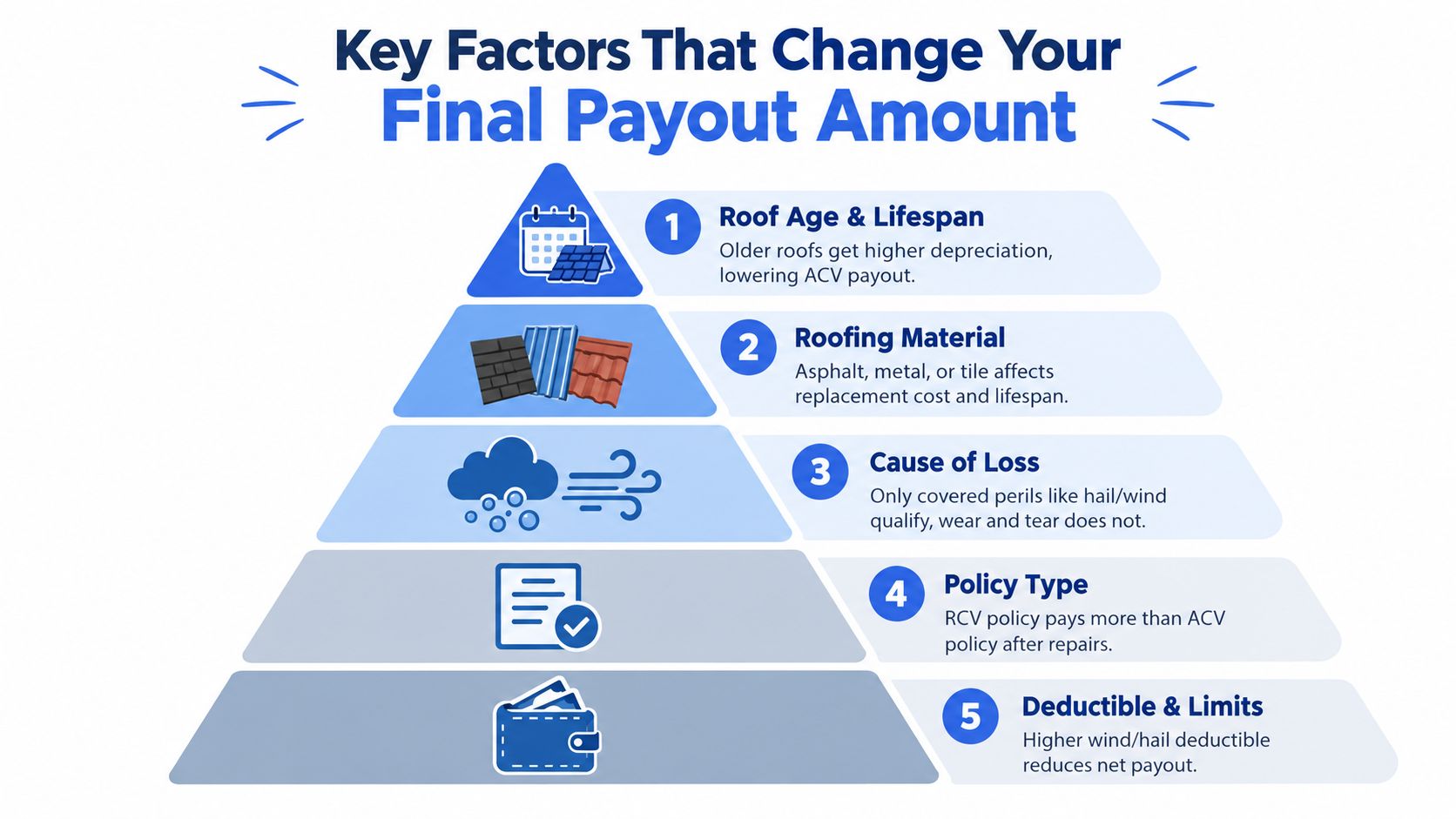
Roof age and expected lifespan
Age drives depreciation. For asphalt composition shingles, Travelers gives a benchmark of 4% depreciation per year on a 25-year roof. On that method, a 10-year-old roof would lose about 40% of its replacement value before the deductible is applied, as explained in Travelers' depreciation guide.
A separate straight-line rule calculates depreciation by dividing roof age by expected lifespan. Under that approach, a 15-year-old roof with a 25-year life could be about 60% depreciated. These are examples of calculation methods, not a promise that every carrier will use the same formula.
Roofing material and scope
Asphalt shingles, metal, tile, and specialty systems have different replacement costs, lifespans, and installation requirements. The insurer's estimate should identify the material class, number of layers, roof sections, flashing, ventilation, underlayment, and related components.
A mismatch between the contractor's scope and the adjuster's scope can create confusion. Measurements, material descriptions, and photographs give both sides a common record to review.
Cause of loss
Insurance generally evaluates why the roof is damaged, not just whether damage is visible. Covered policy perils may include storm-related events, while ordinary aging, neglect, and gradual wear may be excluded. A leak alone doesn't establish coverage.
The date or timeframe of the storm, visible impact or wind damage, interior water intrusion, and pre-loss roof condition can all matter. Don't authorize major work before you understand the carrier's inspection and documentation requirements, except for reasonable temporary measures that prevent further damage.
Policy type and settlement terms
An RCV policy may allow recovery of withheld depreciation after completion. An ACV policy generally leaves depreciation as a permanent reduction. Some policies also contain roof-specific endorsements or schedules that alter how wind or hail damage is settled.
Deductible and policy limits
The deductible comes out of the covered payment. It isn't the same as depreciation, and it isn't recoverable later. A wind or hail deductible may apply separately from the all-perils deductible, depending on the policy.
Finally, policy limits and exclusions can cap or narrow the payment. Review these terms before using a replacement estimate as your expected cash requirement.
Sample Payout Calculations You Can Apply to Your Roof
A simple worksheet can reveal why the contractor's estimate and the first insurance payment don't match. Start with the approved replacement cost, subtract depreciation when the claim is being paid on an ACV basis, then subtract the applicable deductible.
Two useful examples
A state insurance example uses a $10,000 roof replacement and a $4,000 deductible. Under RCV, the initial payment on a total-loss claim would be $6,000. Under ACV, depreciation is subtracted before the deductible, so the payment would be lower, with the exact amount depending on the roof's depreciated value. The example appears in the Texas Department of Insurance explanation of RCV and ACV.
A separate illustration uses a $20,000 roof, $10,000 in depreciation, and a $1,000 deductible. The initial ACV check would be $9,000, calculated as $20,000 minus $10,000 depreciation minus $1,000 deductible. If the policy permits recoverable depreciation, the homeowner could later receive the withheld $10,000 after completing the replacement and submitting the required proof. The homeowner's out-of-pocket share before that later payment would be $11,000, made up of the deductible and temporarily withheld depreciation, as shown in United Policyholders' ACV and replacement cost explanation.
| Scenario | Replacement Cost | Depreciation | Deductible | Initial ACV Check | Recoverable Depreciation | Homeowner Cost |
|---|---|---|---|---|---|---|
| RCV total loss example | $10,000 | Not specified | $4,000 | $6,000 | Not specified | $4,000 deductible, plus noncovered costs |
| RCV illustration after completion | $20,000 | $10,000 | $1,000 | $9,000 | $10,000, if policy requirements are met | $11,000 before depreciation recovery |
| ACV illustration | $20,000 | $5,000 | Policy-dependent | $15,000 before deductible | None unless the policy allows recovery | Deductible plus the depreciated share and noncovered costs |
The deductible is never recoverable depreciation. It remains the homeowner's responsibility even when the policy pays replacement cost.
Use this math as a planning tool, not as a coverage determination. The approved scope, policy language, cause of loss, and insurer's depreciation calculation decide the actual claim.
How to Document Damage and File a Roof Claim Successfully
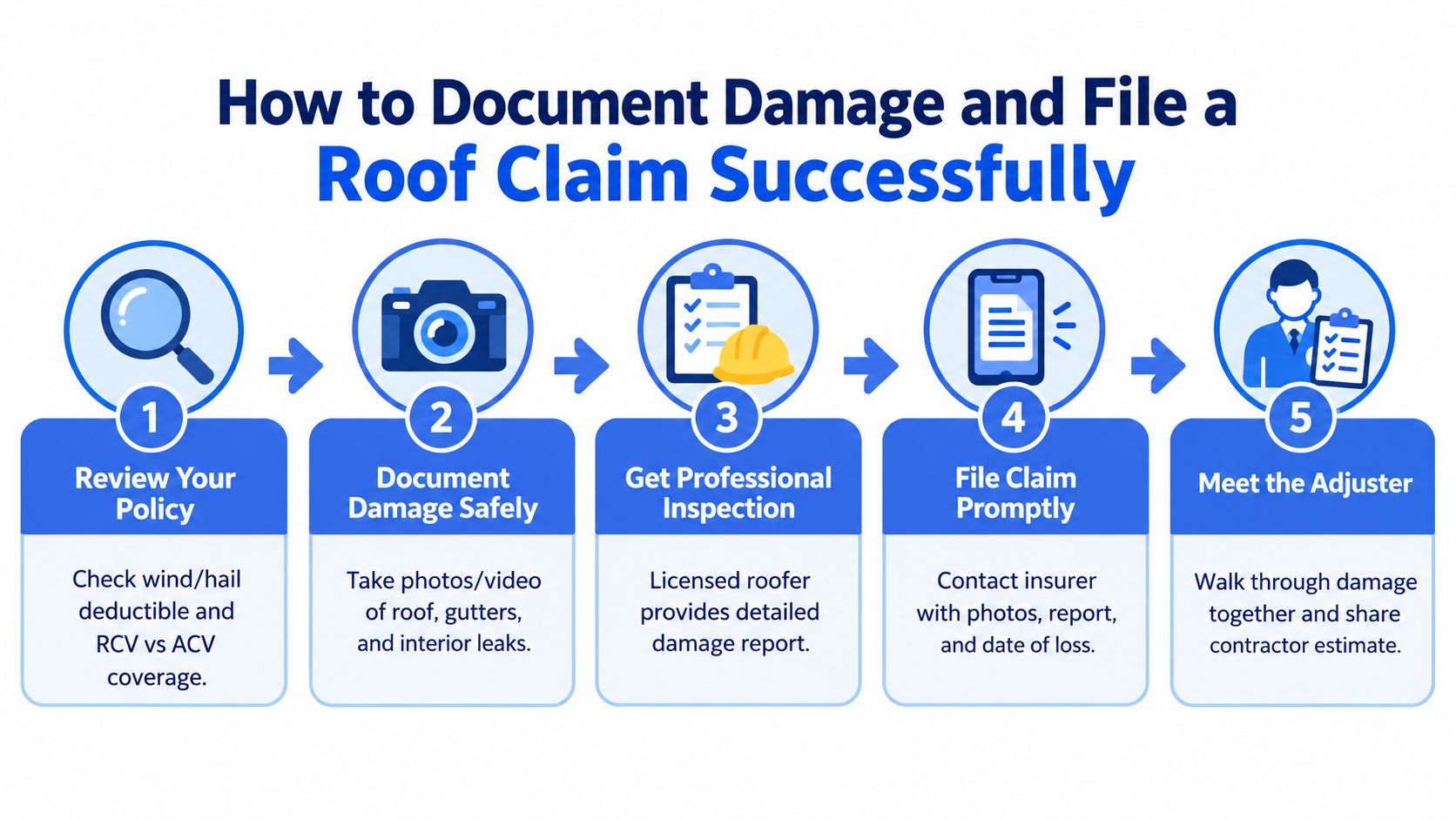
Good documentation gives the adjuster a clearer record of what happened, what was damaged, and what work the roof requires. It also protects your ability to request recoverable depreciation after the replacement.
Start safely and preserve evidence
Don't climb onto a wet or steep roof after a storm. From the ground, document missing shingles, displaced materials, damaged vents, gutters, siding, skylights, and fallen branches. Photograph interior stains, wet drywall, attic conditions, and affected belongings, and note when you first observed the issue.
Prevent further damage with reasonable temporary measures when it's safe. Keep receipts for emergency tarping, temporary protection, and related work, but don't discard damaged materials before the insurer has had a reasonable opportunity to inspect them.
Build a claim file
Collect the policy declarations page, storm date, inspection findings, photographs, videos, repair estimates, adjuster communications, invoices, and completion documents. Ask the insurer what proof it needs before work begins and what deadline applies to recoverable depreciation.
A professional inspection can add useful detail through roof measurements, slope-by-slope photographs, material identification, and a written distinction between storm damage and age-related wear. The roof inspection for an insurance claim process can help organize those observations before the adjuster visit.
For organizing photos and improving image clarity without changing the underlying evidence, homeowners may also find AI real estate photo tools useful for general property documentation. Keep the original, unedited files as the primary record.
Coordinate the adjuster visit
File the claim through your insurer or agent, provide the date of loss and initial evidence, and attend the inspection if possible. Walk through the affected areas, share the contractor's written scope, and ask questions about coverage, depreciation, deductible application, matching materials, and completion requirements.
After replacement, submit the final invoice, completion certificate, photographs, and any other documents requested. The insurer can't release recoverable depreciation until it has the required proof.
Tips to Improve Your Claim Outcome in Columbus
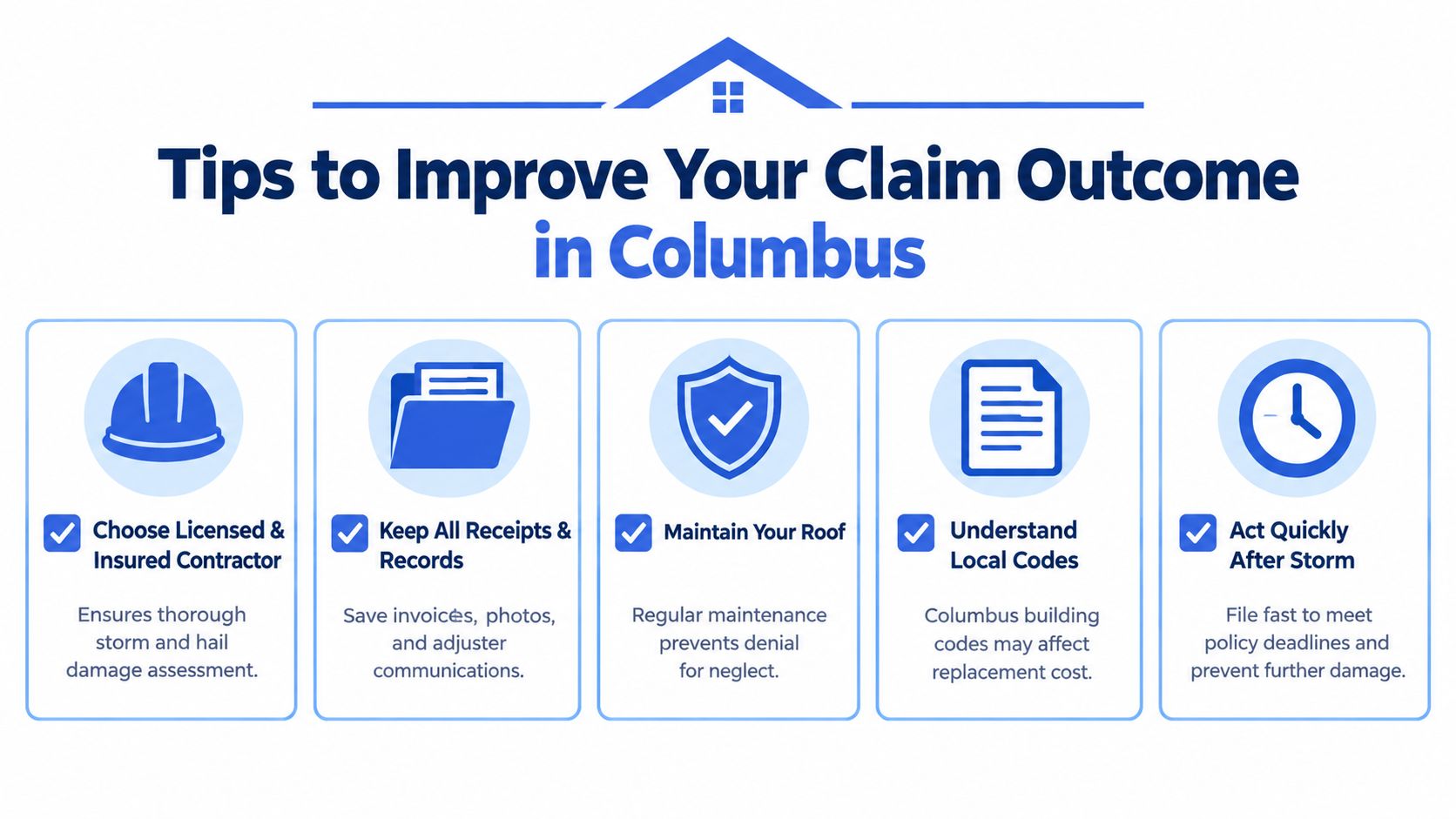
A Columbus roof claim becomes easier to evaluate when the file shows three things clearly: what happened, which damage belongs to that event, and what the requested work will cost. Good records cannot guarantee approval, but they reduce avoidable questions and help explain why the proposed scope fits the loss.
Build a Columbus-specific claim file
Keep storm photographs, maintenance records, prior repair invoices, and earlier inspection reports in one place. Central Ohio weather can bring wind, hail, heavy rain, and falling branches, yet coverage still depends on the policy's listed perils and evidence connecting the roof damage to a covered loss.
A licensed and insured contractor should inspect every roof slope and related exterior component. Request measurements, material identification, photographs, and a written explanation separating sudden-event damage from gradual deterioration. You can also learn how a roof damage insurance adjuster evaluates storm claims in Columbus, which can make the inspection process easier to follow.
Check the deductible before work begins
Your wind or hail deductible directly affects the money you must provide. One 2025 coverage note places the average wind and hail deductible at over $1,700, compared with roughly $1,100 in 2021, as reported in this coverage analysis of rising storm deductibles. Those figures describe the market, not your policy. Read the declarations page for your actual deductible and confirm whether a percentage-based amount applies.
Renewal documents may also change how the roof is settled. Ask your agent whether the policy still uses RCV, has shifted to ACV-only terms, or includes a roof schedule or endorsement that limits recovery.
Track every dollar
Roof replacement costs have risen, which can widen the gap between the first check and the project's final cost. Verisk data reported average residential roof replacement costs of $17,631 in 2025, up 33% from the prior four-year average. Average repair costs reached $4,699, up 25%, according to Insurance Business' report on Verisk roof claim severity data.
Save invoices, supplements, receipts, photographs, and emails. HIBCO ROOF LLC can inspect Columbus-area roofs, document storm damage, and provide repair or replacement estimates for homeowners deciding how to proceed.
Getting Your Roof Replacement Covered and Next Steps
The answer to how much does insurance pay for roof replacement comes down to three core levers: the approved replacement cost, depreciation under the policy, and the deductible. RCV may allow withheld depreciation to be recovered after completion, while ACV generally leaves the depreciated amount as part of your responsibility.
Start today by reviewing the declarations page, confirming the wind or hail deductible, photographing damage safely, and arranging a professional inspection. Keep the claim scope and final invoice together, because the initial check may not be the final payment.
For readers who want broader context on insurance-related outreach and documentation, this guide to insurance prospecting offers background that can help explain why organized records matter in insurance communications.
HIBCO ROOF LLC can inspect your Columbus-area roof, document storm or hail damage, prepare a written scope, and support the insurance claim process without promising coverage. Visit HIBCO ROOF LLC to request a free estimate and discuss whether repair or system-based replacement fits your roof and policy situation.