Yes, most siding can be painted, but vinyl is a conditional maintenance decision rather than a routine requirement, since it generally doesn't require painting, staining, or sealing and can typically be cleaned with mild soap and water. The panels must be structurally sound, clean, and free of cracking or distortion before paint is worth applying.
So why do so many homeowners start by picking a color? That's the last decision, not the first. When you ask can siding be painted, the sharper question is whether paint will change the thermal and warranty conditions the siding was designed to perform under. Walk your house with that question in mind and the right answer usually gets clear fast.
Table of Contents
- Can Siding Be Painted and When It Makes Sense
- Why Vinyl Siding Behaves Differently from Wood
- Preparing Siding Surfaces Before You Paint
- Choosing a Paint Color That Will Not Damage the Siding
- Repainting Versus Replacing Siding in Columbus
- How to Screen Your Own Siding Before Calling Anyone
- Getting a Written Estimate and Taking the Next Step
Can Siding Be Painted and When It Makes Sense
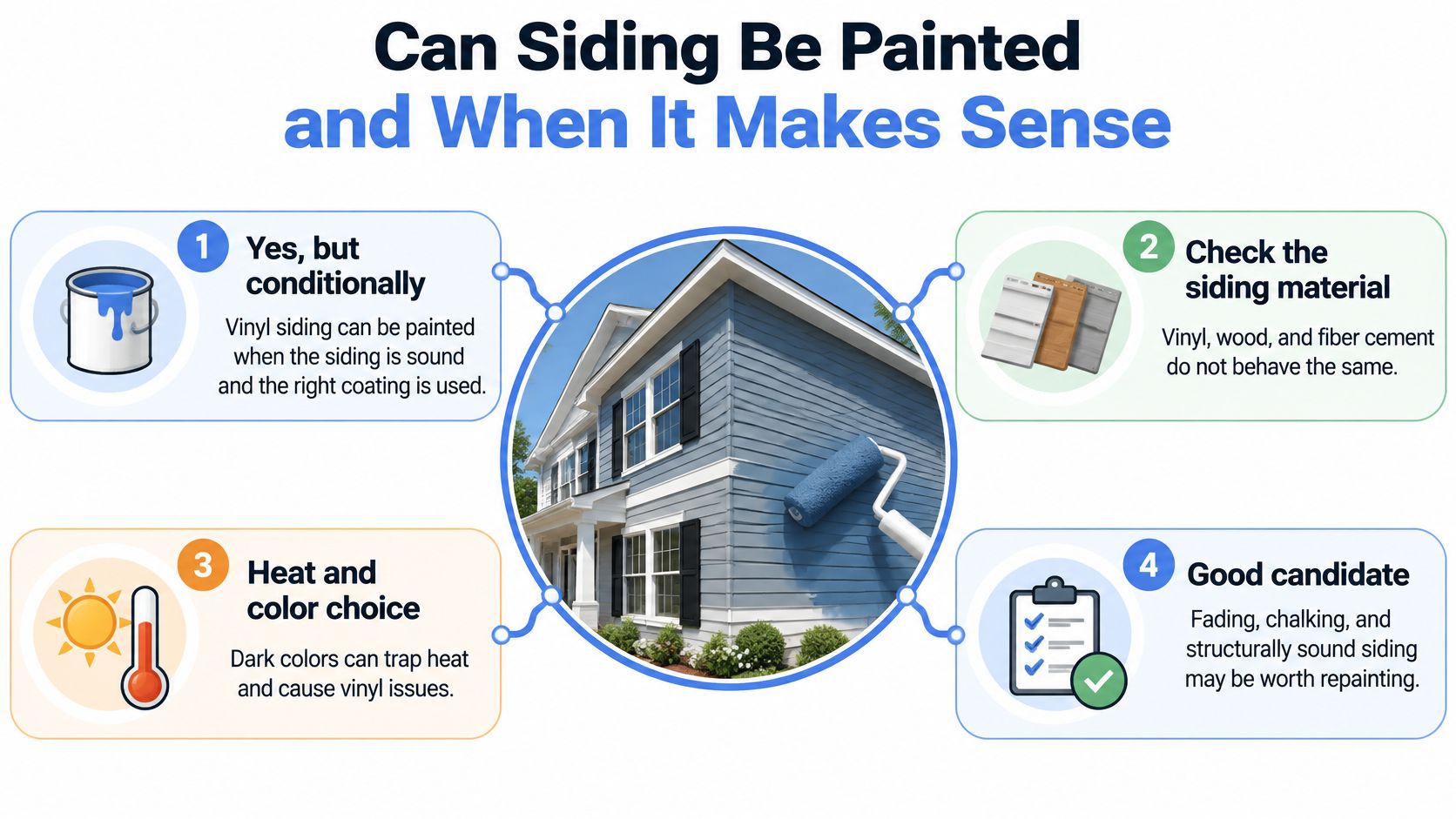
Vinyl can accept paint, but that doesn't mean it needs it. The Vinyl Siding Institute technical guidance on designing with vinyl siding states vinyl generally does not require painting, staining, or sealing and can typically be cleaned with mild soap and water. That's a different starting point than wood, where a coating is part of routine protection.
Painting becomes reasonable in narrower cases. Your panels are firmly attached and intact, you want a new appearance, and replacement would be unnecessarily expensive for siding that still works. Fading and chalking alone can make a sound wall a candidate. Cracking, brittleness, or significant distortion can't be fixed by a coating.
The Five Variables That Decide the Job
- Panel condition: Look for cracks, loose sections, warping, and impact damage before you price paint.
- Original color: Your existing shade sets the safe range for anything you put over it.
- Proposed color: Darker isn't just bolder, it's hotter, and heat drives distortion risk.
- Sun exposure: A shaded north wall and a full-sun south wall don't behave the same.
- Warranty language: Some manufacturers restrict or exclude field-applied coatings, so check before prep starts.
That last point gets skipped constantly. Document your siding brand and color, read the warranty, and get written confirmation for the coating and color you're considering. A practical walkthrough of how to refresh siding with paint is useful once you've cleared those checks, not before.
Screening rule: If the panel itself is failing, you're not looking at a paint job. You're looking at a repair or replacement job with paint as a possible finish step.
For Columbus homes, weigh ultraviolet exposure, freeze-thaw cycles, and storm impacts together. Older siding that's survived all three may look tired but still be sound, or it may be brittle in ways a fresh coat hides for one season. Condition decides, not appearance.
Why Vinyl Siding Behaves Differently from Wood
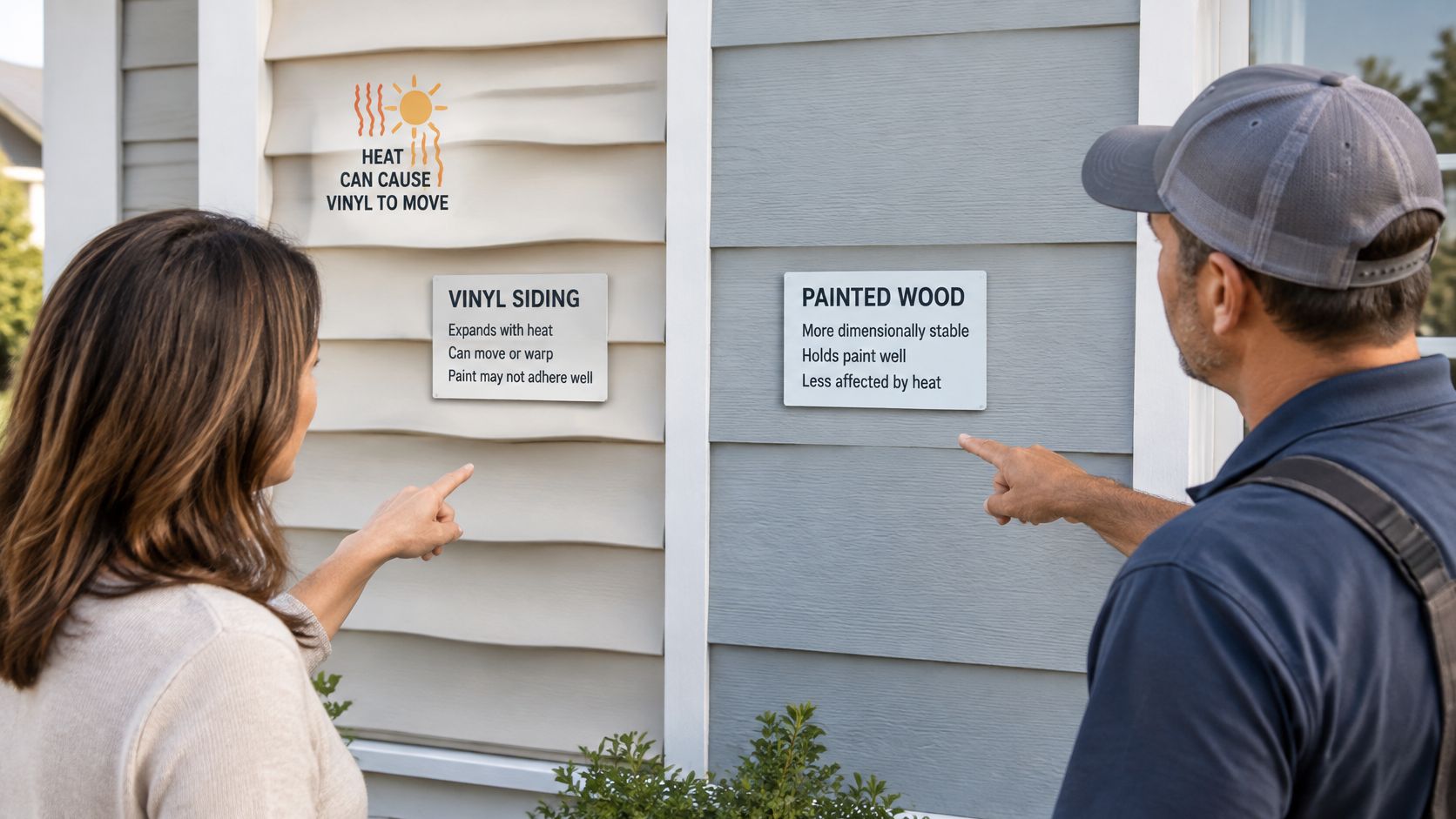
Wood takes paint into a porous surface and moves modestly. Vinyl is a manufactured panel with factory color that runs through the material, and it moves a lot with temperature. The Virginia Department of Historic Resources preservation guide on siding describes vinyl as having a wide range of thermal expansion, where panels installed tightly in winter may expand in summer and panels installed loosely in summer may shrink in winter.
That movement stresses any paint film you lay over it. Add a color that absorbs more solar heat and you raise panel temperatures further, which can contribute to peeling, buckling, or distortion. Wood doesn't punish a dark color choice the same way. Vinyl can, and it's why ordinary exterior paint applied without checking compatibility is a gamble.
Factory Color Is a Tested System
Vinyl color isn't sprayed on at the end. Certification programs evaluate color retention under ASTM D6864 for solid colors and ASTM D7251 for multi-hued or variegated siding, after the siding itself meets ASTM D3679 performance requirements. Historically, fading concerns kept vinyl mostly white and pale. The industry expanded its color-retention certification program in 2006, and by 2009 approximately 350 shades had been listed, with candidate colors subjected to a two-year outdoor accelerated-weathering test.
That history matters because it tells you what you're painting over. You're covering a tested, color-stable surface with a field-applied film that now has to flex, bond, and hold color on its own. When homeowners compare materials, a look at Hardie Board maintenance for Connecticut homes shows how differently fiber cement handles repainting, precisely because it doesn't expand and contract like PVC.
The practical takeaway is simple. On wood, paint is maintenance. On vinyl, paint is a system change, and you should treat coating choice, color choice, and panel condition as one decision instead of three separate ones.
Preparing Siding Surfaces Before You Paint
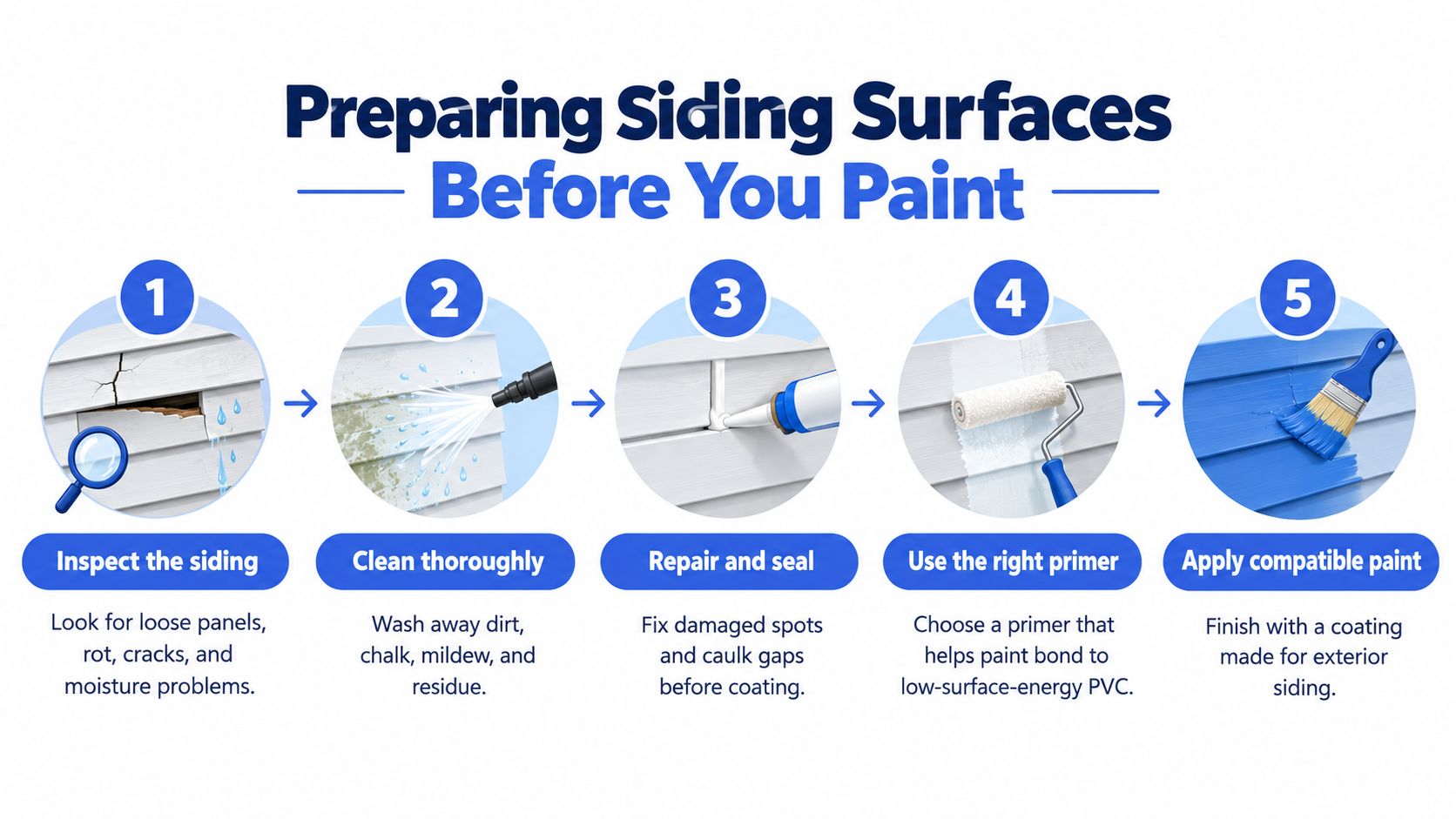
Prep on vinyl is about one problem. PVC has low-surface-energy characteristics, so coatings don't grab it eagerly, and dirt or pollutants left on the surface make adhesion worse. Sherwin-Williams guidance on how to paint vinyl siding recommends scrubbing with warm, soapy water, rinsing thoroughly, and letting the siding dry fully before coating.
The Sequence in Order
- Wash thoroughly: Scrub with warm, soapy water so you're coating vinyl, not chalk, mildew, or residue.
- Rinse completely: Soap film left behind interferes with bonding just like dirt does.
- Dry fully: Don't trap moisture under a fresh film.
- Test adhesion: Apply a compatible exterior or latex primer to a small test area first.
- Coat only if the test holds: Proceed only if the dried primer stays intact without lifting or blistering.
The adhesion test isn't busywork. Some vinyl compositions resist bonding, and finding that out on one panel beats finding out across a whole elevation. If primer is used, it should be an appropriate exterior primer, though certain exterior latex systems may not require priming. Follow both the coating and siding manufacturers' instructions rather than guessing.
Weather is part of prep, not scheduling trivia. Conventional exterior specifications commonly require air, surface, and material temperatures of at least 50°F, with no immediate rain, fog, or unfavorable drying conditions, per the Sherwin-Williams standard exterior coatings specification. In Columbus, stable spring, summer, and early-fall windows are preferable to cold snaps or rapidly changing conditions.
For a deeper look at sequencing and surface checks, how professionals prepare surfaces for painting covers the logic painters use before a coating ever touches the wall. Pair that with basic routine vinyl siding care practices and you'll know what's normal maintenance versus pre-paint work.
One limit to respect. Prep can't rescue cracked, loose, or warped panels. Clean and test only the walls that pass a condition check first.
Choosing a Paint Color That Will Not Damage the Siding
Color is where homeowners get hurt, because they shop it like interior paint. On vinyl, darker colors absorb more solar heat and can cause heat distortion, buckling, or warping. The Sherwin-Williams exterior coatings specification with the LRV threshold identifies a Light Reflective Value threshold of 56, meaning colors with an LRV below 56 shouldn't be used on vinyl unless they're specifically designated as VinylSafe colors.
The same guidance says not to paint vinyl a color darker than its original color, and warns that disregarding the siding manufacturer's painting instructions may void the product warranty. So the order of operations is fixed. Compare the proposed color against your original siding color, check its LRV, then review the warranty before anyone opens a can.
Color and Warranty Risk by Siding Type
| Siding Type | Color Change Tolerance | Heat and Movement Risk | Warranty Exposure |
|---|---|---|---|
| Vinyl | Low, stay at or lighter than original unless an engineered darker system is approved | High, wide thermal expansion plus solar heat gain | High, field coatings may be restricted or excluded |
| Wood | High, wide palette with proper prep and primer | Moderate, moisture movement matters more than heat | Lower, repainting is expected maintenance |
| Fiber cement | High, holds paint well when prepared correctly | Low, dimensionally stable compared with PVC | Moderate, follow manufacturer coating instructions |
| Aluminum | Moderate to high with compatible exterior coatings | Moderate, heat gain but no PVC style distortion | Moderate, depends on product and coating guidance |
That table explains why a charcoal makeover that's fine on fiber cement can be a problem on light beige vinyl. It's not taste. It's panel temperature. If you want a noticeably darker result, you need the paint manufacturer and the siding manufacturer to specifically approve an engineered darker-color system, in writing.
Sun exposure sharpens the risk further. A borderline color on a shaded wall may sit fine while the same color on an unshaded west wall runs hot every summer afternoon. Browsing coordinated color schemes for vinyl siding is worth doing with your original color and its LRV in hand, so the palette you fall for is one your panels can carry.
If a contractor will put any color you point at on vinyl without asking about the original shade, keep looking.
Repainting Versus Replacing Siding in Columbus
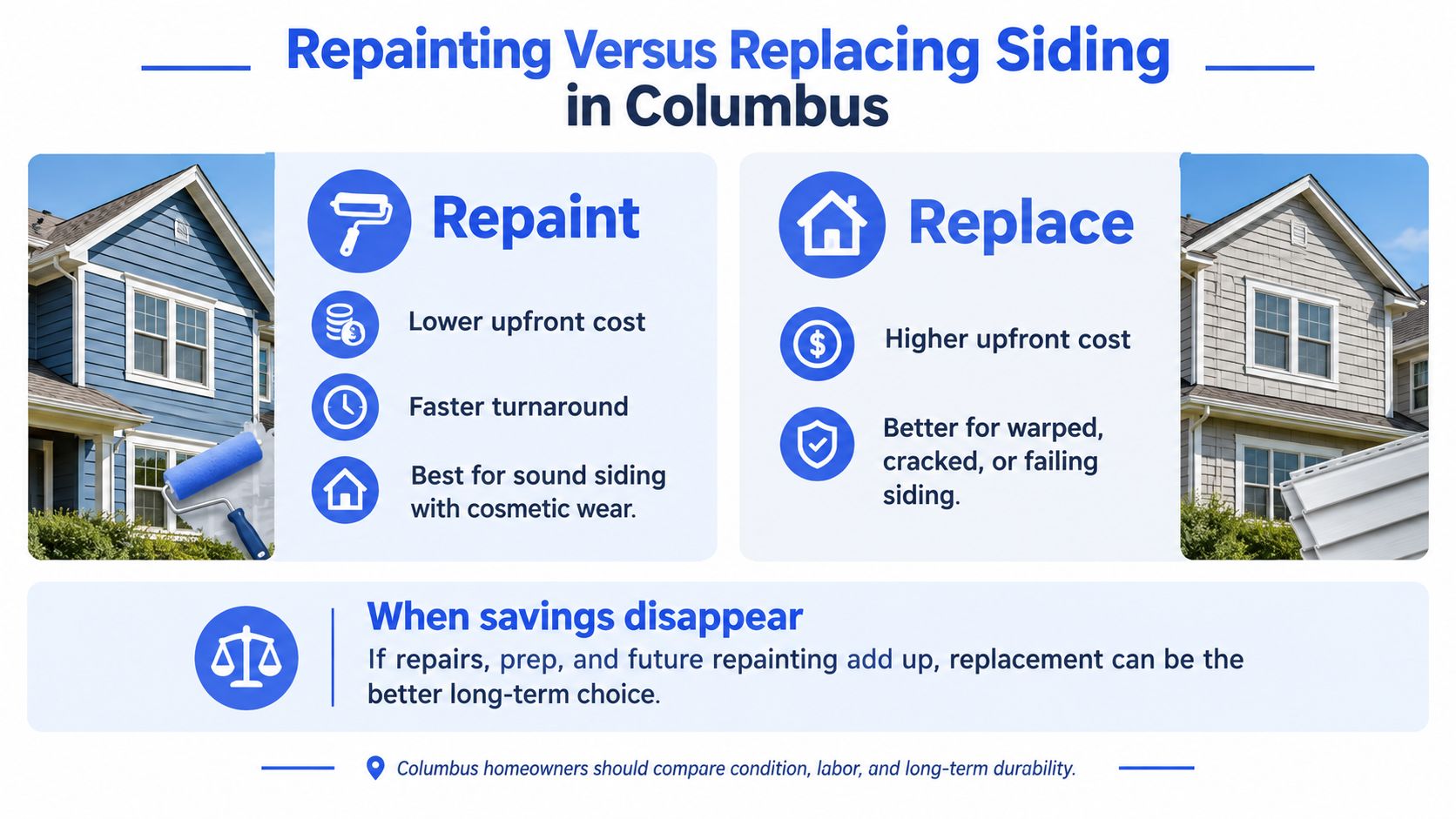
Paint is usually pitched as the cheap option. Sometimes it is. But field-painted siding may require another coating cycle in roughly 5 to 10 years, a horizon laid out in this overview of siding lifespan claims and maintenance limits, while unpainted vinyl is marketed as requiring little routine maintenance with very long manufacturer-stated service lives. Once you paint, you've put a low-maintenance product on a repaint schedule. That's a real cost, even if it arrives years later.
Those broad lifespan claims cut both ways. They don't account for damaged panels, fading, failed caulk, water intrusion, or installation defects. A wall can be well inside its stated service life and still be a poor paint candidate.
Compare the Total Scope, Not the Sticker
- Cleaning and repairs: Washing, adhesion testing, and fixing loose or damaged sections before coating.
- Primer or specialty coating: Vinyl-compatible products cost what they cost, don't substitute down.
- Labor and access equipment: Two-story elevations and steep lots change the math.
- Future touch-ups and recoats: Budget the next cycle now, not when it peels.
- Warranty implications: A voided siding warranty has a dollar value if panels later fail.
- Remaining life of the siding: Painting panels near the end of their useful life buys little.
Paint also can't correct buckling, impact damage, poor flashing, or moisture behind the cladding. If those are present, you're paying to coat a problem. Compare that against what a full vinyl siding replacement typically involves cost-wise before you decide paint is the savings play.
The reverse case is just as real. If your siding is structurally sound and you only want a compatible color refresh, replacement is wasteful. You're tearing off working cladding to fix appearance.
The question worth asking on every estimate is this. What condition must this siding be in for painting to stay financially rational? Sellers and storm-affected homeowners especially need that answered with inspection photos, because cosmetic fading and envelope-performance problems look similar from the curb and price out completely differently.
How to Screen Your Own Siding Before Calling Anyone
You can run a useful first pass yourself in one slow walk around the house. Work in order, because each check can end the paint conversation early and save you an estimate built on a bad assumption. This is the same screening logic behind the advice to treat painting as a warranty and failure-risk decision, not just a color project.
Your Walk-Around Sequence
- Check panel condition first: Press gently, look for cracks, brittleness, loose sections, warping, and storm impact marks.
- Identify what you have: Write down the siding brand and original color if you can find them on paperwork or panel markings.
- Note sun exposure by wall: Mark which elevations bake in afternoon sun, since those carry the highest heat risk.
- Read the warranty before any prep: Look specifically for language on field-applied coatings and approved colors.
- Define your proposed color: Compare it against the original and check whether it's darker.
- Get compatibility in writing: Obtain confirmation for the specific coating and color before work is priced as a paint job.
Some findings should stop the process entirely. Cracked, loose, warped, or impact-damaged panels need repair or replacement first. Signs of moisture damage behind the cladding, like soft sheathing at trim or staining below joints, point to an envelope problem that paint will seal in rather than solve.
Stop sign: If panels flex, rattle, or crumble at the edges when handled, don't price paint. Price the underlying fix.
Central Ohio adds its own wear pattern. Freeze-thaw exposure works on joints and brittle edges, summer solar gain stresses hot walls, and storm impacts crack panels that already have years of ultraviolet exposure on them. Damage often clusters on one or two elevations while the rest of the house is fine, which is why isolated panel repair sometimes beats both full repainting and full replacement.
Call for a professional inspection when you find damage you can't classify, moisture signs you can't trace, or warranty language you can't interpret. That's also the point where photos from your walk-around become useful, because they let a contractor see the pattern before arriving.
Getting a Written Estimate and Taking the Next Step
A useful estimate for this decision does more than name a price. It should document panel condition by elevation, note your siding brand and color, confirm coating and color compatibility, and separate cleaning and repairs from coating and labor so you can see where the money goes. If replacement is the more defensible answer, the estimate should say why in writing.
Have a few things ready before the visit. Bring any warranty paperwork, the siding brand and color if known, your walk-around photos, and a clear statement of your goal. A color refresh and a fix for a performance problem lead to different scopes, and saying which one you want upfront saves a second visit.
Timing matters too, since exterior coating work in central Ohio depends on stable temperatures and dry conditions. According to Sherwin-Williams surface preparation and weather guidance, products designed for colder conditions may be applied as low as 35°F, while painting vinyl above 90°F should be avoided unless the product is designed for it. Book the inspection now, even if the work lands in the next good weather window.
If your walk-around left you unsure whether your Columbus home needs paint, panel repair, or full siding replacement, HIBCO ROOF LLC offers free, no-pressure written estimates that document panel condition and lay out the repaint-versus-replace scope side by side. As a licensed and insured central Ohio exterior contractor, the team will tell you plainly when painting is the right call and when it's money wasted on failing panels. Visit the site today to schedule your inspection and get the decision in writing.