Wind and hail represented 40.5% of homeowners insurance losses in 2018 and 48.3% in 2020, so hail is a major reason residential claims turn into repair disputes. A credible hail damage repair estimate must document more than visible shingle bruising.
The storm may have passed, the neighborhood may look normal, and your roof may appear intact from the driveway. Then you notice granules in the gutters, a dented vent cap, or a ceiling mark that wasn't there before. Your insurer sends an adjuster, a contractor sends an estimate, and suddenly you have two scopes that don't seem to describe the same house.
That difference doesn't automatically mean someone is wrong. One document may describe the insurer's initial payment, while the other identifies the work required to restore the complete roofing system. The important question isn't which total looks more convincing. It's whether each estimate explains the damage, quantities, payment basis, and missing components clearly enough for you to compare them.
Table of Contents
- Understanding Your Hail Damage Repair Estimate
- How Contractors Build a Repair Estimate
- What Drives the Cost of Hail Damage Repairs
- Contractor vs Insurer Estimates – Key Differences
- Preparing for Your Hail Damage Insurance Claim
- Final Tips for Columbus Homeowners
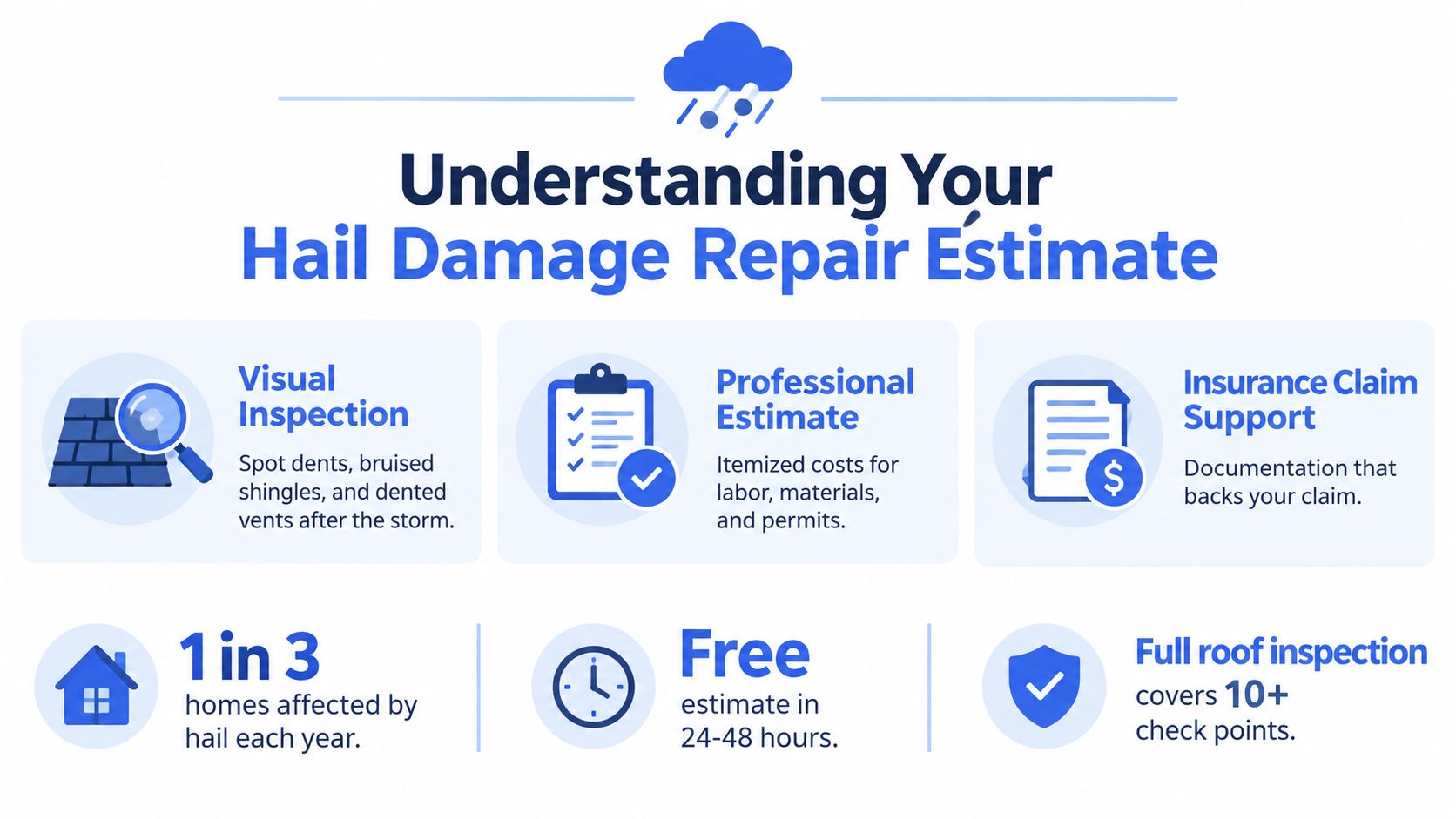
Understanding Your Hail Damage Repair Estimate
A hail damage repair estimate is not just a price tag. It should function as a working record of what happened, what was damaged, what must be repaired, and how the proposed work was priced. That record matters because wind and hail accounted for 40.5% of homeowners insurance losses in 2018, 38.3% in 2019, 48.3% in 2020, 39.8% in 2021, and 40.7% in 2022, according to Insurance Information Institute loss data based on ISO and Verisk records.
The same source reports an average paid wind or hail claim of $13,511 across 2018 through 2022, but that figure includes multiple property components and isn't limited to roofing. It also reports that approximately one in 35 insured homes files a wind or hail property-damage claim in a typical year. Those figures give context, not a quote for your house. A roof-only repair could be much smaller, while damage involving siding, gutters, skylights, and interior water intrusion could approach or exceed that benchmark.
What the document should establish
A useful estimate answers four practical questions:
- What was damaged: It identifies the affected slopes and exterior components, including shingles, underlayment, flashing, vents, skylights, gutters, siding, paint, and interior finishes.
- How much is damaged: It provides measured quantities rather than a lump-sum replacement amount.
- What work is recommended: It explains localized repair, slope-level replacement, or full-system replacement and why.
- What the price includes: It separates labor, materials, disposal, code-related work, permits, access assumptions, and the deductible.
Hail size can help prioritize an inspection, but it doesn't prove that your roof is covered for replacement. A Columbus guide to what size hail damages roofs can help you understand why storm reports matter, but the estimate still needs physical evidence from your property.
Your roof also isn't the only place to look. Gutters and downspouts can show impact marks, while painted metal, vent caps, siding, skylights, attic insulation, and ceilings may reveal collateral or interior damage. If you're evaluating other storm-exposed building elements, this resource on Texas impact glass requirements explained provides useful context for how impact resistance and building requirements can differ by component and jurisdiction.
The right estimate gives you control. It lets you ask the insurer why a line is absent, ask the contractor why a line is necessary, and decide whether the proposed work restores the property properly.
How Contractors Build a Repair Estimate
A reputable contractor doesn't start by naming a replacement price. The contractor starts by establishing whether the reported storm caused functional damage and which parts of the roofing system are affected.

The inspection comes before the scope
The inspection should cover each roof slope, not just the easiest section to reach. The contractor records slope direction, shingle type, approximate age and condition, penetrations, valleys, ridges, hips, flashing interfaces, vents, skylights, drip edge, gutters, and visible interior effects.
The National Roofing Contractors Association identifies several hail-related damage mechanisms, including granule loss, edge material removal, penetration, fracture, and severe wood splitting. It also explains that asphalt shingles become more brittle with age. The NRCA guidance on roof repair after a hailstorm makes an important distinction: not every hail mark reduces service life or creates a need for replacement.
That distinction protects you from two bad outcomes. A contractor shouldn't expand the scope based on cosmetic marks alone, but an adjuster shouldn't dismiss functional damage because the bruising looks minor from the ground.
Measurements turn observations into quantities
Roof geometry drives the material calculation. Measurements should account for slope areas, pitch, perimeter, valleys, hips, ridges, penetrations, starter strip, ridge cap, underlayment, flashing, ventilation, and waste associated with the roof's complexity.
A sound estimate then breaks the work into line items. Instead of “replace roof,” it might identify tear-off, underlayment, shingles, starter, ridge cap, flashing work, ventilation components, disposal, and related exterior repairs. This makes the document easier to compare with insurer pricing and easier to revise if hidden decking damage appears after tear-off.
The estimate should also label assumptions. Access conditions, decking condition, permit fees, waste removal, material availability, and code requirements can all affect the final scope. Homeowners who want broader background on contractor coverage and insurance considerations can consult this roofing insurance 2026 guide, but the property-specific estimate still has to stand on its own.
Practical rule: If the estimate doesn't show where the damage is and how the quantities were calculated, it isn't ready for a serious insurance comparison.
Preserve evidence before anyone applies sealant, coating, or mastic. Those materials can conceal impact characteristics needed to evaluate whether the damage is cosmetic, functional, localized, or widespread.
What Drives the Cost of Hail Damage Repairs
The cost changes when the scope changes. A few cosmetic marks on one slope are not equivalent to fractured shingles across multiple elevations with damaged flashing, gutters, and interior water intrusion.
Material selection is one major variable. The estimate should identify the existing shingle type and the proposed replacement, including whether the material is available and whether a matching issue affects the recommended scope. A replacement estimate also needs to account for starter strip, ridge cap, underlayment, ventilation, drip edge, flashing, fasteners, disposal, and labor. Omitting those components can make an estimate look attractively low while leaving you to resolve the shortfall later.
Roof geometry matters just as much as shingle price. Steep pitches, complex hips and valleys, multiple penetrations, difficult access, and additional safety requirements can change labor and waste assumptions. A simple roof and a complicated roof shouldn't be expected to produce the same line-item structure.
Compare the scope, not just the total
Collateral damage often explains a substantial difference between two documents. Check whether each estimate addresses:
- Metal components: Gutters, downspouts, flashing, vent caps, and other exposed metal can provide corroborating impact evidence.
- Roof system layers: Underlayment, starter strip, ridge cap, ventilation, and drip edge may be absent from a short insurer scope.
- Adjacent surfaces: Siding, paint, skylights, windows, and exterior trim may require separate inspection.
- Interior effects: Attic materials, ceilings, insulation, and finished areas should be documented where water entered.
- Compliance work: Local code requirements should be separated from direct loss-related repairs.
FEMA recommends impact-rated asphalt shingles carrying Class 4 resistance under UL 2218 or ANSI/FM 4473, as described in its windstorm resilience fact sheet. That classification describes a test result. It doesn't prove that an existing roof escaped functional damage, and it doesn't automatically require you to upgrade an undamaged roof.
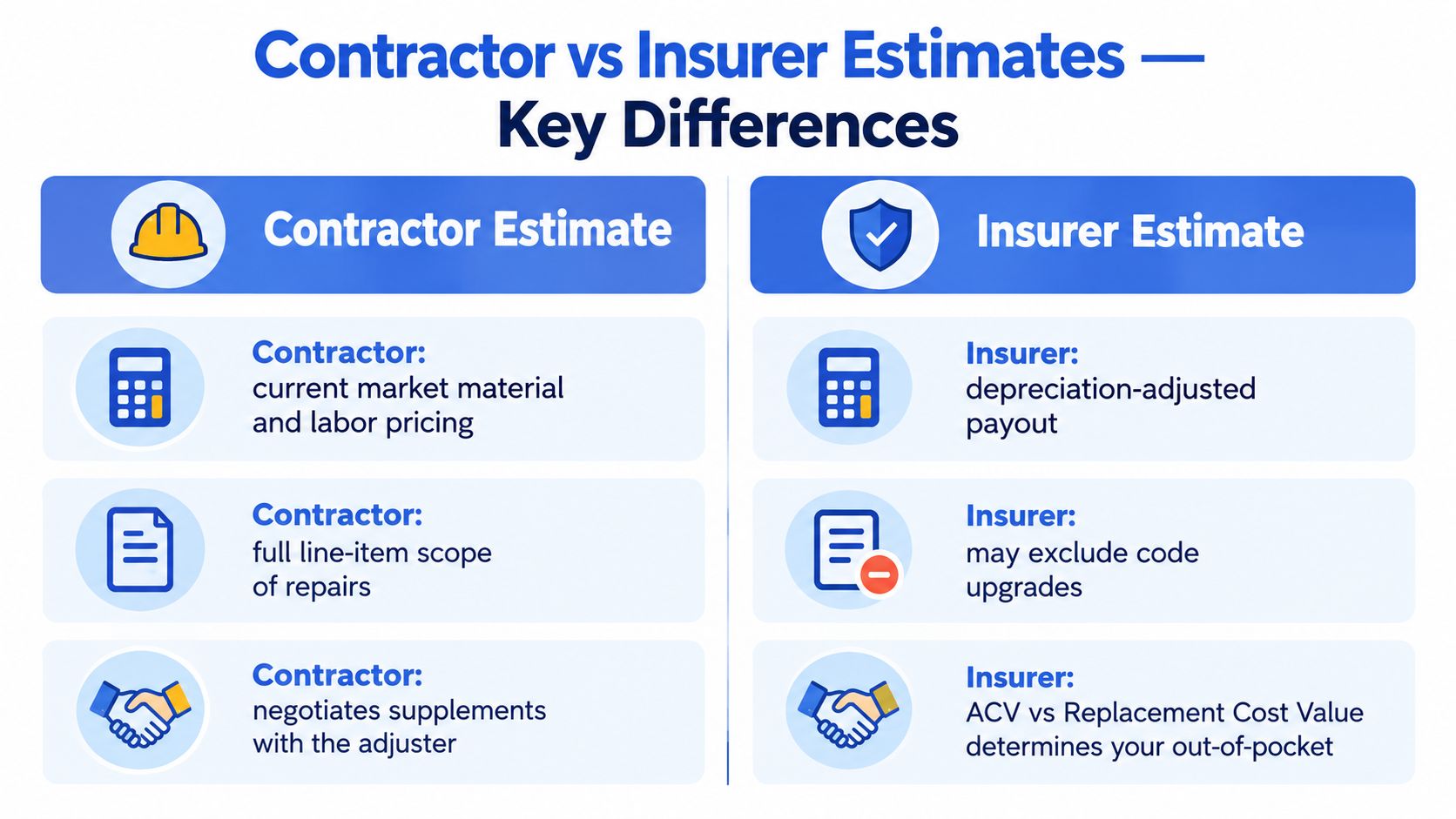
Your contractor's estimate may use current labor and material pricing, while an insurer's estimate may use standardized pricing and policy-specific rules. Neither total settles the issue by itself. The defensible approach is to compare quantities, components, assumptions, and coverage treatment line by line.
Contractor vs Insurer Estimates – Key Differences
The most common mistake is treating the insurer's first estimate as the final value of the repair. It may be an initial adjustment based on what the adjuster could observe, the estimating system used, and the policy's payment mechanics. A contractor who performs a closer inspection may identify damaged components or required work that weren't included.
ACV and RCV affect the payment
Actual cash value, or ACV, generally reflects the pre-loss value of the roof after depreciation. Replacement cost value, or RCV, is tied to the cost of replacing the damaged property with comparable materials, subject to policy terms. With replacement-cost coverage, an insurer may initially withhold depreciation and release recoverable depreciation after completed repairs.
That means an estimate can show a repair scope that appears adequate while the initial payment is lower than the contractor's contract amount. The difference may involve depreciation, a deductible, excluded code work, or components the adjuster didn't include. A state insurance department explanation of ACV and replacement cost treatment also notes that policy deadlines can apply, often around 180 days, so read your policy and claim correspondence instead of assuming withheld depreciation will remain available indefinitely.
Use a reconciliation sheet
Ask for a side-by-side comparison with these columns:
| Question | Contractor's scope | Insurer's scope |
|---|---|---|
| What damage is documented? | Slope-labeled photos and observations | Adjuster photos and observations |
| What quantities are included? | Measured areas and component counts | Insurer estimating line items |
| What payment basis applies? | Contract amount before policy deductions | ACV, RCV, depreciation, and deductible |
| What is missing? | Code, access, flashing, ventilation, collateral work | Exclusions, assumptions, or omitted components |
| What happens next? | Revised scope or supplement request | Reinspection, review, or approved supplement |
Don't ask only, “Why is your estimate higher?” Ask, “Which physical finding supports this line, and where is it addressed in the insurer's scope?” For guidance on working with an adjuster, use this practical resource about roof damage and an insurance adjuster.
A contractor should be able to explain the repair-versus-replacement recommendation without claiming that every disagreement requires a full replacement or legal escalation. The insurer should be able to explain exclusions and depreciation without reducing the discussion to a single unexplained total.
Preparing for Your Hail Damage Insurance Claim
Start with evidence, not cleanup. Photograph the roof from safe locations, then record close-ups of representative impact marks and wider images showing the affected slope. Photograph gutters, downspouts, flashing, vent caps, siding, skylights, attic areas, ceilings, and any visible water entry.
The National Association of Insurance Commissioners advises homeowners to notify the insurer and agent after a loss and to state whether they have photographs, videos, and repair-cost estimates. Its post-disaster claims guide also supports assembling written damage and cost documentation before or during the claim process.
Follow a disciplined sequence
- Record the loss: Note the storm date, affected areas, visible damage, roof age, repair history, and any existing leaks or prior work.
- Protect the property: Use temporary weatherproofing only where an actual opening or active risk exists. Don't make permanent repairs before the insurer has a reasonable opportunity to inspect when circumstances allow.
- Keep every receipt: Save invoices for tarping, emergency repairs, water extraction, or other mitigation work.
- Open the claim promptly: Provide the policy and claim information, your photographs, your written damage list, and the contractor's labeled report.
- Request the insurer's estimate: Ask for the complete scope, payment basis, deductible treatment, depreciation, and any stated exclusions.
- Compare line by line: Match tear-off, underlayment, flashing, ventilation, accessories, disposal, related exterior damage, and code items against the contractor's scope.
NAIC consumer guidance specifically recommends photographing or recording damage before cleanup or repairs, making necessary temporary repairs to prevent additional damage, and saving receipts. Its consumer guidance on documenting storm damage also cautions against completing permanent repairs before the insurer has inspected when circumstances permit.
Don't let a contractor erase evidence before the adjuster arrives. Don't let an adjuster close the file without addressing documented damage. If the two scopes differ, send a written reconciliation with labeled photographs and ask for a reinspection or supplement review.
For a practical checklist covering the claim process and roof documentation, use this hail damage roof insurance claim guide. Keep communication in writing, and save the policy language that controls ACV, RCV, roof payment schedules, wind or hail deductibles, and deadlines.
Final Tips for Columbus Homeowners
Central Ohio homeowners should treat a hail inspection as a building-envelope review, not a quick glance at shingles. Hail can affect the roof, gutters, siding, skylights, painted metal, attic, and finished interiors, and the estimate should show which areas were inspected and what evidence was found.
Hail reports can help prioritize an inspection. A NOAA-based compilation recorded 87,206 hail events across 3,026 U.S. counties from 2016 through 2025, including 19,666 events with hail measuring at least 1.75 inches, or approximately 22.6% of recorded events, as reported in this hail activity analysis. That threshold can justify closer attention, but it isn't proof of coverage or a replacement requirement. Physical damage remains the deciding evidence.
A strong estimate tells the same story from three angles: the storm event, the observed damage, and the proposed repair.
Choose a licensed and insured local contractor who will provide a written, measured scope and explain the difference between cosmetic wear and functional damage. Require dated photographs, slope labels, component quantities, repair assumptions, and a clear separation between loss-related work and code-required upgrades. If the insurer's estimate is lower, compare the documents before accepting a payment or authorizing permanent work.
HIBCO ROOF LLC provides Columbus-area inspections, storm and hail documentation, written repair and replacement estimates, roof repairs, and related exterior work including gutters, siding, windows, and skylights. The company also offers insurance-claim assistance and adjuster-meeting support for homeowners who need help reconciling scopes.
If your Columbus-area property has suspected hail damage, HIBCO ROOF LLC can inspect the roof and related exterior components, document the findings, and prepare a written estimate for your insurance comparison. Contact the team for a free, no-pressure inspection before temporary evidence disappears or permanent repairs begin.