
Plan on about 20 years for standard three-tab asphalt shingles and about 30 years for architectural asphalt shingles, according to The Roofing Brief research summary. Many new roofs have a typical design life of about 20 years, but a printed warranty year is not a replacement date.
An older federal field survey found a different regional pattern. The National Bureau of Standards roofing survey reported average roof ages of 16 years in states north of approximately the 40th parallel, compared with 12 years in states south of it. Columbus sits just south of that line, so national estimates are useful benchmarks, not promises for a particular home.
Around 20 years, documented inspections become more useful than guesswork. Shingles can lose wind resistance, flexibility, and sealant strength before water reaches the ceiling. A poorly vented younger roof may age faster than an older roof installed and ventilated well.
Table of Contents
- Asphalt Shingle Lifespans by Type
- Why the Warranty Year Is Not the Lifespan
- What Shortens Shingle Life in Central Ohio
- Wind Resistance After the First Decade
- Maintenance That Protects Remaining Years
- Failure Signs and the Repair or Replace Decision
Asphalt Shingle Lifespans by Type
Shingle type gives homeowners a useful starting point. In 2026, The Roofing Brief research summary estimated about 20 years of service for standard three-tab asphalt shingles and about 30 years for architectural asphalt shingles. These are typical ranges, not a schedule for replacing every roof.
Why Published Ranges Look So Wide
The Roofing Brief's report on roof ages and materials gives a broader 20-to-30-year range for asphalt shingles. That span reflects how product type, climate, and installation conditions can differ. A roof in central Ohio may face different wear from a roof in a milder climate, so the range is a starting point, not a forecast for a specific home.
The National Roofing Contractors Association's roofing resources identify about 20 years as a typical design-service expectation for many new roofs. This is a planning benchmark. A roof does not automatically fail at that age, and poor attic ventilation can shorten the useful life of a younger roof.
Practical rule: Use the upper end of a range for budgeting only when an inspection shows the shingles, flashing, roof deck, and ventilation are in sound condition.
Use the Benchmarks as a Lookup, Not a Guarantee
| Benchmark | Typical service life | How to use the number |
|---|---|---|
| Standard three-tab asphalt | About 20 years | Inspect closely as the roof approaches this range |
| Architectural laminated asphalt | About 30 years | Longer service depends on sound installation and ventilation |
| Second layer over an existing roof | Usually less remaining life than a full tear-off | An overlay can conceal problems in the existing roof |
| Typical new-roof design expectation | About 20 years | A planning benchmark, not a guaranteed failure date |
| Historical average north of the 40th parallel | 16 years | Older field conditions, not a prediction for a current roof |
| Historical average south of the 40th parallel | 12 years | Older field conditions; central Ohio sits just south of the 40th parallel |
| Broad published consumer range | 20 to 30 years | A general range that varies with product and conditions |
The historical 16-year and 12-year averages come from older field conditions and materials. They provide context, not a verdict on a modern roof. Heat, sun, and severe weather can push shingles toward the shorter end of their expected life.
An overlay adds a new shingle layer over the old one rather than exposing the deck in a full tear-off. That can hide soft decking, old flashing problems, and curled shingles that keep the new layer from lying flat. As a result, an overlay generally offers less remaining life than replacing the roof down to the deck.
Use age to decide when to arrange a closer inspection. Condition determines whether the roof needs attention now or can remain in service.
Why the Warranty Year Is Not the Lifespan
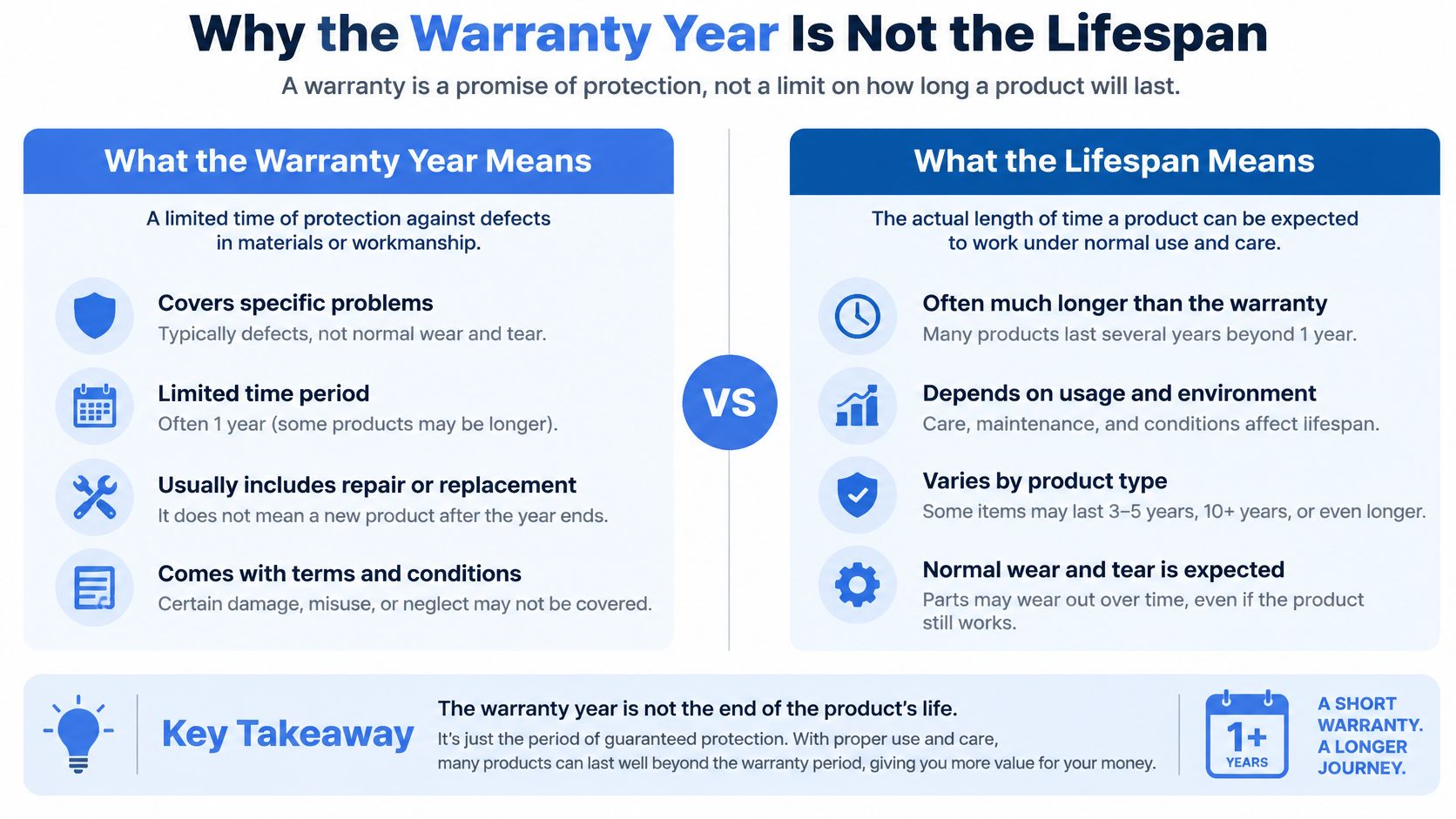
A 30-year or lifetime label does not promise that shingles will shed water for that long. It describes limited remedies for specified manufacturing defects under stated conditions. The coverage may not apply to ordinary weathering, storm damage, faulty flashing, or installation problems.
Warranty length also does not directly measure shingle weight, thickness, or performance. The largest number on the wrapper is not a forecast of how many years the roof will last.
What Changes After the First Decade
A warranty can keep its “lifetime” label even as the amount available for a qualifying defect declines. The 2026 Roofing Brief lifespan report says standard lifetime architectural-shingle lines commonly provide about 10 years of full, non-prorated coverage, followed by a prorated schedule. Check the paperwork to see when that change happens and what defects qualify.
Enhanced coverage may have additional requirements, such as installation by a certified contractor and matching system components. These can include approved underlayment, starter shingles, hip and ridge products, and ventilation. For example, the GAF System Plus warranty explanation describes one warranty option. Compare its terms, not just the headline years.
A shingle warranty works more like a limited parts promise on a car than a mileage forecast. It may cover a qualifying defect, but it does not predict when other parts will wear out. Likewise, a warranty does not tell you when a roof will stop shedding water.
Keep the Paperwork That Proves the Installation
- Save the installation record: Keep the contract, product names, color, completion date, and warranty registration together.
- Check the proration terms: Find when full coverage ends, what counts as a manufacturing defect, and which accessories an enhanced option requires.
- Plan from condition: Use the roof's age, attic moisture, flashing condition, granule loss, and shingle flexibility to decide when to arrange an inspection.
A warranty explains who may pay for a qualifying defect. An inspection helps determine whether the roof still sheds water.
That distinction can matter during a home sale or insurance conversation. A long warranty label does not establish that the roof is in good condition. Ask for the installation date and a condition report, too.
What Shortens Shingle Life in Central Ohio
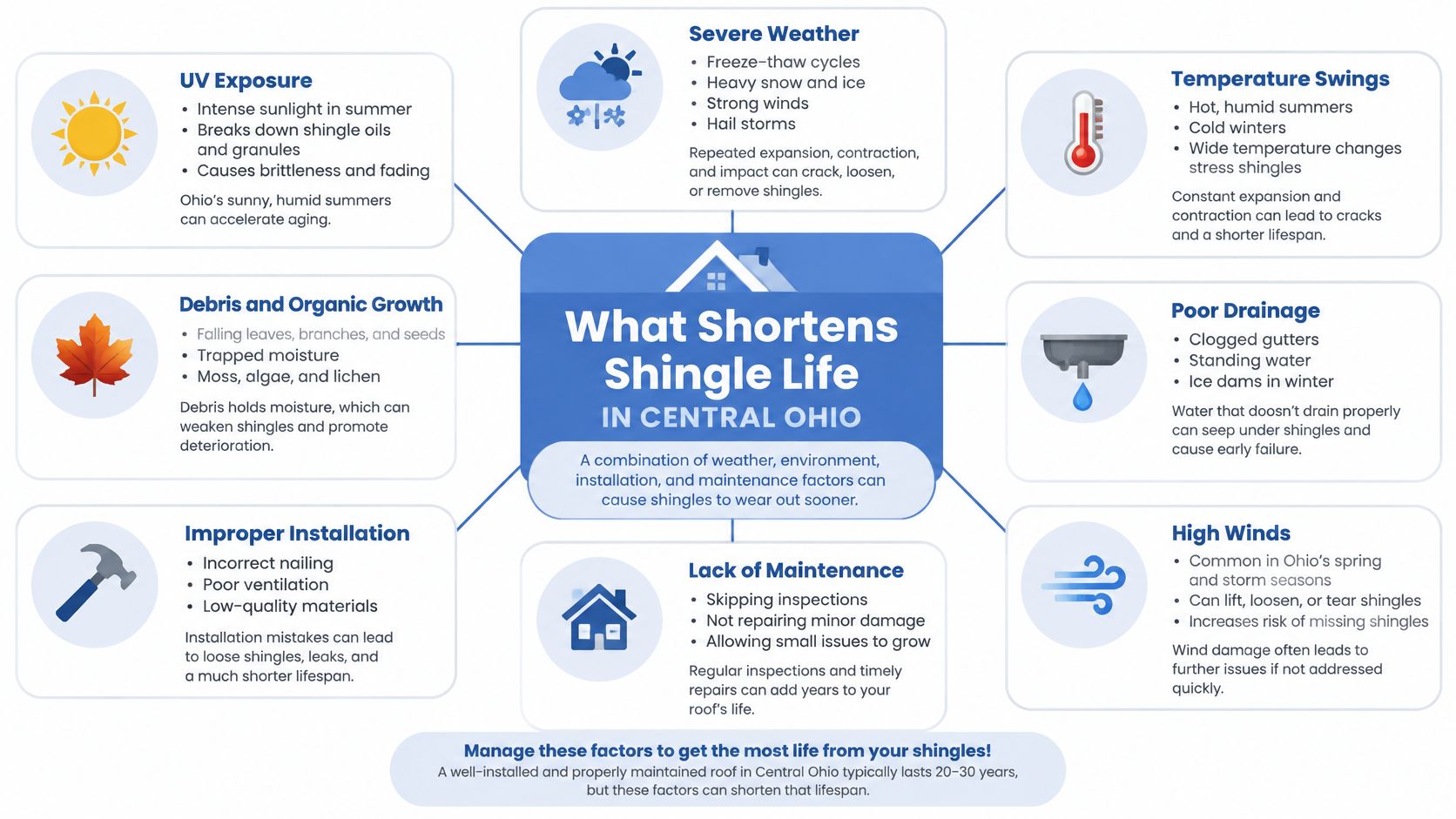
Two identical shingles can age at different speeds on the same house. One slope receives direct afternoon sun, another stays shaded and wet, and a third takes wind-driven rain at an exposed rake edge. Calendar age is the same for all three, but remaining life isn't.
Central Ohio combines several stresses in one year. Summer heat and ultraviolet light dry the asphalt, freeze and thaw cycles work at cracks and fasteners, hail bruises the mat, and wind tests every sealant bond. The National Institute of Standards and Technology durability publication identifies solar heat, ultraviolet exposure, temperature cycling, freeze-thaw events, wind uplift, hail, and moisture as interacting causes of degradation. Those forces don't take turns politely. They compound each other's damage.
Heat From Above and Heat From Below
A south or west slope can bake for hours while the attic below it adds more heat. Picture a dark raincoat left on a car dashboard through July. It doesn't just fade. It stiffens, cracks when folded, and loses the flexibility that made it useful. Shingles follow a similar path as asphalt compounds age under heat and sun.
Attic ventilation is therefore part of roof life, not a minor accessory. Blocked soffit intake, undersized exhaust, or bathroom fans dumping moist air into the attic can leave heat and humidity under the deck. Heat accelerates weathering from below, while moisture can move, stain, or deteriorate sheathing. Once the deck shifts or softens, fasteners hold less securely and shingles sit on an unstable base.
A shaded north slope has the opposite problem. It dries slowly after rain, collects leaves in valleys, and supports algae or moss. Dark streaks alone don't prove failure, but persistent moisture and debris make nearby laps, flashing joints, and exposed fasteners worth checking.
Installation Defects Can Start the Clock Late and End It Early
- Misplaced nails: Nails driven too high can miss the reinforced nailing zone, while overdriven nails can cut through the mat.
- Missing starter course: Eaves lose the sealed first row that helps the exposed course resist wind lifting.
- Poor alignment: Uneven courses can expose fasteners or leave too little headlap where water needs time to drain downhill.
- Cold-weather sealing problems: Sealant strips may need suitable warmth and clean contact to bond, so a roof can enter its first windy season without full adhesion.
- Flashing shortcuts: A pipe boot, chimney step flashing, or valley detail can leak years before the field shingles wear out.
Hail adds hidden uncertainty. A strike can bruise or fracture the mat and loosen granules while rows still look neat from the driveway. The exposed asphalt then ages faster in sunlight. You can't judge that damage reliably by color alone, which is why close inspection of the mat and granule pattern matters after a storm.
The contrarian point: A younger roof with poor ventilation or a wet deck can be closer to failure than an older, lightly exposed roof that has been vented and maintained well.
Ask a better question at inspection than, "How old is it?" Ask which mix of roof orientation, ventilation, moisture, storm exposure, and installation quality is using up the remaining life. The answer points to a fixable cause instead of a vague prediction.
Wind Resistance After the First Decade
Can a roof look intact and still be weaker in the next windstorm? Yes. The sealant strip that bonds one shingle course to the next can weather before tabs crack or ceilings stain.
The Insurance Institute for Business and Home Safety ten-year aging release describes field research comparing asphalt shingles after five and ten years across multiple climate zones, including aging sites in Ohio, South Carolina, and Wisconsin. Many products initially gained wind resistance as sealants activated, but most began declining between years five and ten. The amount of decline varied by product, climate, roof orientation, and location.

What a New Shingle Wind Class Does and Doesn't Say
Laboratory classes describe tested products under controlled conditions, not your aged roof after seasons of heat and lifting. The IBHS Roof 101 guide explains that ASTM D3161 places shingle panels in front of a fan jet for two continuous hours, with Class A tested to 60 mph, Class D to 90 mph, and Class F to 110 mph. A product fails if its sealant releases and the shingles lift.
ASTM D7158 takes a different route. It measures uplift forces and tests whether sealed samples provide more mechanical resistance than the calculated force for a specified short gust. That's useful product information, but neither method can certify the sealant condition on a particular house in year twelve.
Wind also attacks edges first. Rakes, eaves, ridges, corners, and changes in slope see uplift and turbulent flow that the middle of a broad slope may not. One unsealed tab can flap, crease, and expose fasteners. The next gust gets under it more easily, and a small failure can travel along a course.
What to Check After About Ten Years
Look for lifted edges, unsealed tabs, diagonal creases, missing pieces, displaced ridge caps, and flashing pulled loose at rakes or eaves. Photograph each slope from the ground and note the date and storm. Don't pry up brittle shingles to test bonds yourself, because you can break a weak mat and create the opening you were trying to diagnose.
An inspection is warranted after severe wind or hail even when there's no ceiling stain. A dry ceiling only proves water hasn't reached the room yet. It doesn't prove the sealant survived. Homeowners who need help deciding where visible storm effects end and structural or water entry concerns begin can read about when storm damage needs professional assessment before debris cleanup hides the evidence.
Wind lifespan and leak lifespan aren't identical. A roof can stop being storm-ready while it still looks acceptable on a calm day.
Maintenance That Protects Remaining Years
Maintenance can't reset an aging shingle to new condition. It can stop avoidable water, debris, and heat from stealing the service life that remains. The goal is to catch a small failed detail while the surrounding field is still flexible enough to repair cleanly.
Build a Twice-Yearly Ground Check
Walk the property each spring and fall, and again after hail or high wind. Use binoculars from the ground, a dormer window, or another safe vantage instead of walking a steep or brittle surface. Look for missing tabs, lifted edges, slipped ridge caps, debris in valleys, and fresh dark patches where granules have washed away.
Check gutters and downspout outlets during the same visit. New piles of coarse granules after every rain deserve attention, although a small amount can shed from a newer roof. Keep gutters open so water doesn't linger at the eave, soak fascia, or back up near the starter course during heavy rain and ice.
Trim limbs that scrape the surface or dump wet leaves onto one slope. Clear debris from valleys and behind chimneys, where trapped moisture can keep laps and flashing wet. A maintenance calendar makes these tasks easier to sequence, and this preventive roof maintenance guide offers a useful checklist structure.
Clean Gently and Fix Small Openings Early
Algae and moss call for a roof-safe cleaner and a gentle method. Don't pressure wash asphalt shingles. A concentrated jet can strip the granules that shield asphalt from the sun, loosen laps, and force water where it doesn't belong. If access, slope, or heavy growth makes the work unsafe, professional roof cleaning by Cultivate House Detailing is one option to evaluate for method, runoff control, and shingle compatibility.
Inside the attic, confirm soffit vents aren't buried under insulation and exhaust openings aren't blocked by stored boxes or bird nests. Look for daylight where it shouldn't appear, damp insulation, rusted nail tips, and dark staining around penetrations. Correcting airflow won't restore cracked shingles, but it reduces the heat and moisture load on the ones that remain.
- Repair promptly: Address a lifted tab, split pipe boot, cracked flashing joint, or exposed fastener before wind enlarges the opening.
- Avoid burying failure: Don't add another layer over brittle, curled shingles just to postpone a tear-off decision.
- Photograph the same slopes: Take spring and fall photos from matching spots so a new bald patch or lifted course is obvious.
Small, repeated observations beat one urgent search after water reaches drywall.
Failure Signs and the Repair or Replace Decision
Say one central Ohio house has a 16-year three-tab roof with bald tabs, gutters full of granules, and a soft spot beside a pipe boot. The bundle label may have sounded longer, but that roof is losing system function now. Say a neighboring 22-year architectural roof has flexible, sealed shingles, dry decking, and one torn pipe boot. The second roof is older, yet a targeted repair may be the sound choice.
Failure means the assembly can no longer shed water reliably. A public asphalt-shingle specification identifies significant granule loss, exposed underlying fibers or felt, widespread curling and splitting, and valleys or ridges that leak beyond repair as failure indicators, and it treats failed underlayment as failure of the roofing system. Shingles are the visible layer, not the whole roof.
Match Each Symptom to a Lean
| What you see | What it usually means | Lean |
|---|---|---|
| Heavy granules in gutters or bald spots | Sun protection is gone and the mat is exposed | Replace if widespread |
| Curling, cupping, or cracking on many slopes | Shingles have lost flexibility | Replace |
| A few missing or torn tabs | Localized wind or fastener failure | Repair if the field is still sound |
| Lifted edges after wind with no interior leak | Sealant bond is weakening | Inspect, repair only the failed area if limited |
| Moss or dark algae streaks alone | Shade and moisture, not automatic failure | Clean and correct moisture, replace only if the mat is damaged |
| Stains in several rooms or recurring leaks | Water is getting past the assembly | Replace when sources are widespread |
| Soft or sagging deck | Sheathing is wet or structurally tired | Replace and repair the deck |
| One bad pipe boot or flashing piece | A penetration failed while the field is intact | Repair |
Don't diagnose a leak by standing directly under the ceiling stain. Water can enter at a flashing joint, travel along decking or a rafter, and appear several feet away. Homeowners tracing an intermittent stain can use roof leak advice from Restore Heroes to organize photos, weather timing, and attic observations before someone opens the roof.
Apply a Three-Part Test
First, place age against type. A three-tab roof near its benchmark has less margin for repeated repairs than a younger architectural roof. A second layer gets still less benefit of the doubt because the deck and first layer are hidden. Age doesn't decide the case alone, but it tells you how much value a repair can realistically buy.
Second, judge the pattern. One cracked pipe boot on a flexible field favors repair. Bald shingles on several slopes, recurring leaks from separate areas, cracked tabs that break during lifting, or soft decking favor replacement. A repair that requires disturbing brittle surrounding shingles can create new fractures, and that practical test often settles the argument. Photographs of brittle tabs, exposed mat, and impact marks in this roof shingle damage guide can help you describe what you're seeing.
Third, ask about hidden wind margin and moisture. A dry ceiling doesn't prove sealant bonds remain strong, and a clean-looking slope doesn't prove the attic deck is dry. Ask whether ventilation problems will keep damaging a repaired area. Replacing pipe boots while leaving a steamy, under-vented attic untouched may solve one leak and preserve the cause of the next one.
Ask for a Written Condition Record
A useful inspection notes roof age, shingle type, slope, attic ventilation, flashing condition, granule accumulation in gutters, exposed mat, lifted or missing shingles, and moisture evidence in the attic. It should separate localized defects from field-wide aging and explain whether underlayment or decking appears compromised. You'll make a better decision from that record than from a verbal percentage of life remaining.
We provide free roof inspections and explain whether a repair or replacement is the best option. If a roof can be repaired, we say so. If replacement is the better long-term investment, we explain why, without pressure or sales tactics. HIBCO Roof is an Owens Corning Preferred Contractor, but the inspection still begins with your roof's condition, not with a predetermined sale.
If the answer remains uncertain, get that documented assessment before the next hail season, a home sale, or an insurance conversation. You'll know whether you're buying a few reliable years with a focused repair or paying repeatedly to patch a system that has already lost its water-shedding function.
If your Columbus roof is nearing its benchmark, showing lifted tabs, or leaking after storms, HIBCO ROOF LLC can inspect the shingles, flashing, deck, and attic ventilation and explain whether repair or replacement makes sense for its remaining life. Schedule a free, no-pressure assessment through HIBCO ROOF LLC and get a written basis for your next step.