
The most popular shortcut is wrong. Looking up the year the house was built does not tell you the age of the roof an insurer will underwrite. Most roofs are replaced at least once, and storm work often covers one slope while the rest stays original. If you want to know how to determine age of roof for insurance, start with the year of the latest complete replacement, then rank the proof behind that year.
Table of Contents
- Evidence That Proves Roof Age, Ranked
- Pulling Records and Building the Insurance File
- Estimating Age From Shingles and Stamps When Records Are Gone
- Attic Checks That Confirm or Challenge an Estimate
- Confirm the Age Your Insurer Will Use Before You Renew
Evidence That Proves Roof Age, Ranked
A records-first method beats a condition guess. The National Association of Insurance Commissioners homeowner shopping materials ask for roof type and "approximate age," which is a signal that an exact calendar date is not always on file at underwriting. Those same materials also push homeowners to document property with photographs and descriptions that include age and value.
Pull the re-roof permit from the city or county and set it beside the original construction permit. The build year does not establish the current roof. Then stack invoices, warranties, disclosures, photos, and prior claim files, and reconcile conflicts before you send anything.
| Rank | Evidence | What it proves | Confidence |
|---|---|---|---|
| 1 | Re-roof building permit | Install month and year | Highest |
| 2 | Paid roofing invoice or completed contract | Install date | High |
| 3 | Manufacturer or installer warranty with registration date | Install year | High |
| 4 | Closing disclosure or seller disclosure | Reported roof date | Medium |
| 5 | Dated before-and-after photographs | Year of work | Medium |
| 6 | Prior insurance inspection or claim file | Year documented | Medium |
| 7 | Aerial imagery history | Window of a few years | Low to medium |
| 8 | Visual estimate by a qualified inspector | Age range only | Lowest |
A permit or a paid invoice can support a month and year. A registered warranty usually supports a year, not a day. A seller disclosure is a reported date, useful when it matches a permit and weak when it stands alone. Dated photos and an old claim file document that work happened in a given year. Aerial history only brackets a change to a window of a few years. A qualified visual read narrows an age range. Surface wear generally cannot prove a calendar year, so never write it as an install date.
Also check overlays and partial replacements. One house can hold sections installed years apart, and a single age line will mislead the underwriter. Older roofs already draw harder questions about eligibility, which is why insurance challenges with older roofs are worth reading before you guess. If the paper trail is thin, a documented roof inspection for an insurance claim can record condition without pretending to be a permit.
Working rule: Record the best-supported month and year, name the source, and label anything weaker as approximate.
Pulling Records and Building the Insurance File
A house's construction year is not necessarily the roof's age. Insurers may assess roof age, condition, material, and shape when setting homeowners premiums, and an older home may not qualify for every program. Some carriers may also require updates to the roof or other major systems, while newer or impact-resistant roofs may qualify for discounts. A file that lists only “built in 1998” does not show when the roof was last fully replaced. The National Association of Insurance Commissioners discusses these factors in its consumer guidance.
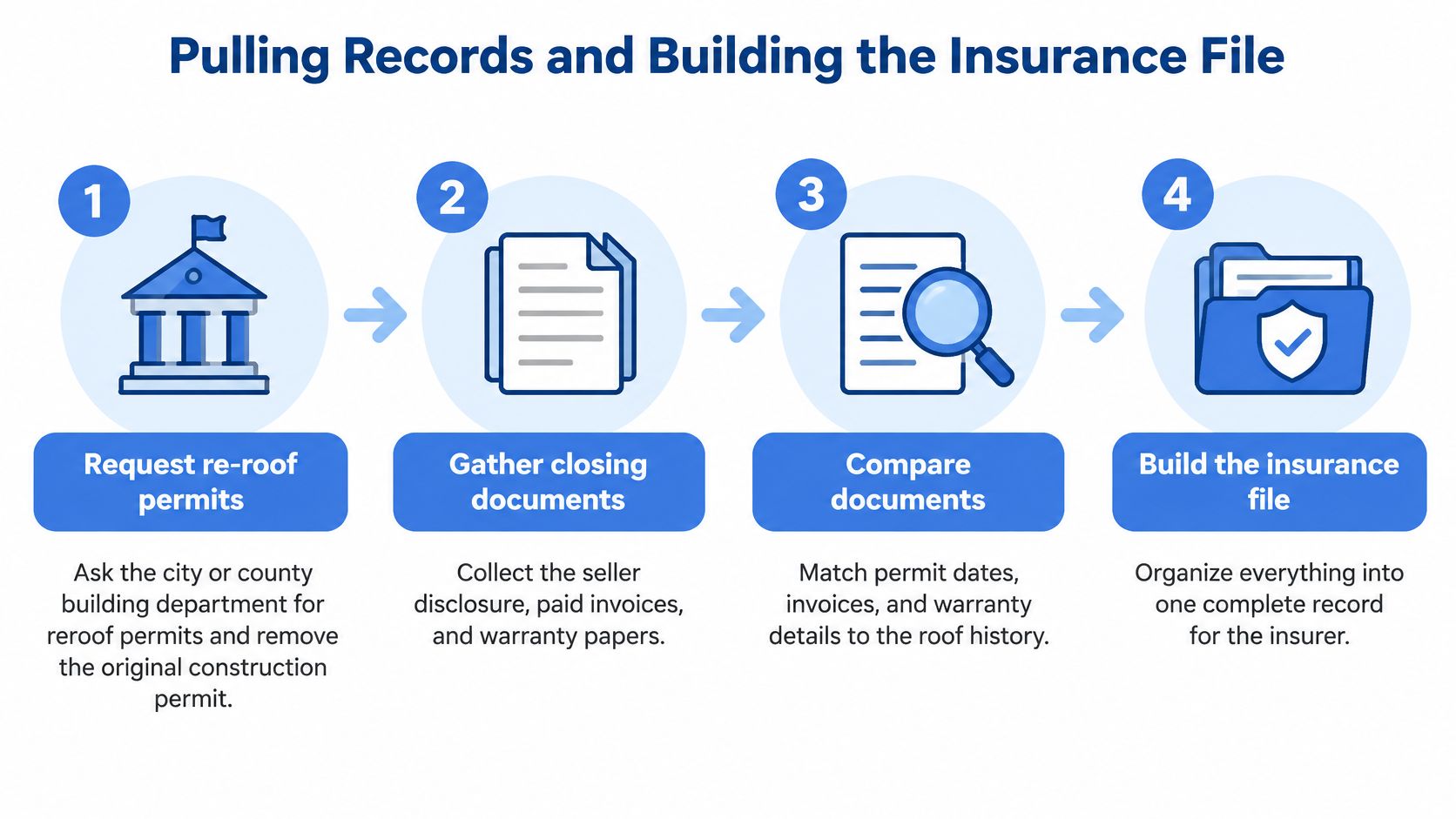
Seven pulls, in order
- Request re-roof permits. Ask the city or county building department for roofing permits, then separate the original construction permit from records of later roof work.
- Gather closing paper. Check the closing disclosure, seller disclosure, paid invoices, warranty registration, appraisal notes, and inspection reports. Treat a reported date as stronger when it agrees with work records.
- Find dated photos. Search listing materials, claim files, and phone records for timestamped before-and-after images. They can document that work occurred in a given period, though they may not establish the exact installation date.
- Scan aerial history. Compare roof color, pattern, and visible penetrations. Aerial images can help bracket when a change happened, but they provide a window rather than a precise date.
- Reconcile conflicts. If a permit says 2016 and an invoice says 2017, keep both in the file. Identify which record gives the stronger support and mark the conflict unresolved rather than presenting one date as certain.
- Split the roof by section. Storm repairs often replace one slope. A home bought after a storm may have an invoice covering only the damaged planes, so ask which slopes were replaced and which were left.
- Write one summary line. State the supported installation month and year, identify the record behind it, and label confidence. If the evidence supports only a year or a range, do not turn it into a specific month.
What goes in the file
Keep original records and digital copies of permits, invoices, warranty paperwork, dated photos, prior claim files, and any signed inspection that states an age range and explains its basis. Give each replaced section its own date. Mark a visual estimate as approximate, and ask the carrier which records it accepts before uploading photos without context.
Florida's 2025 statutes define roof age by the date when 100% of the surface was built or replaced, or by the initial date of a partial replacement when later work completed the full surface. That provides a useful way to distinguish a full replacement from a patch: a repair to one area does not make the entire roof new.
How the valuation method changes the check
The Insurance Information Institute defines actual cash value as replacement cost minus depreciation, with depreciation reflecting age, obsolescence, and wear. Its example compares a 15-year-old roof damaged beyond repair: replacement cost pays for a comparable new roof, while actual cash value pays a smaller amount after depreciation.
| Valuation method | How the payment is calculated | Effect of roof age |
|---|---|---|
| Replacement cost value (RCV) | Cost of a comparable new roof | Age affects eligibility and documentation, not the payment amount |
| Actual cash value (ACV) | Replacement cost minus depreciation | Older roofs carry more depreciation and a smaller payment |
| Split or partial replacement | Payment for damaged sections only, valued by each section's age | Each section must be dated separately |
Together, permits, invoices, photos, and inspection reports give the insurer a record it can review when assessing eligibility, discounts, depreciation, or a required replacement. Keep the summary tied to the strongest documentation, and separate confirmed dates from approximate estimates.
Estimating Age From Shingles and Stamps When Records Are Gone
A house's build year does not establish the age of its roof. When replacement records are missing, use the shingle type, visible condition, and any surviving product stamps to estimate an age range. A visual assessment can indicate condition and likely remaining service, but it cannot establish an installation date as firmly as records. Give the insurer the range, your confidence level, and the limits of the inspection so the adjuster can apply the carrier's rules.
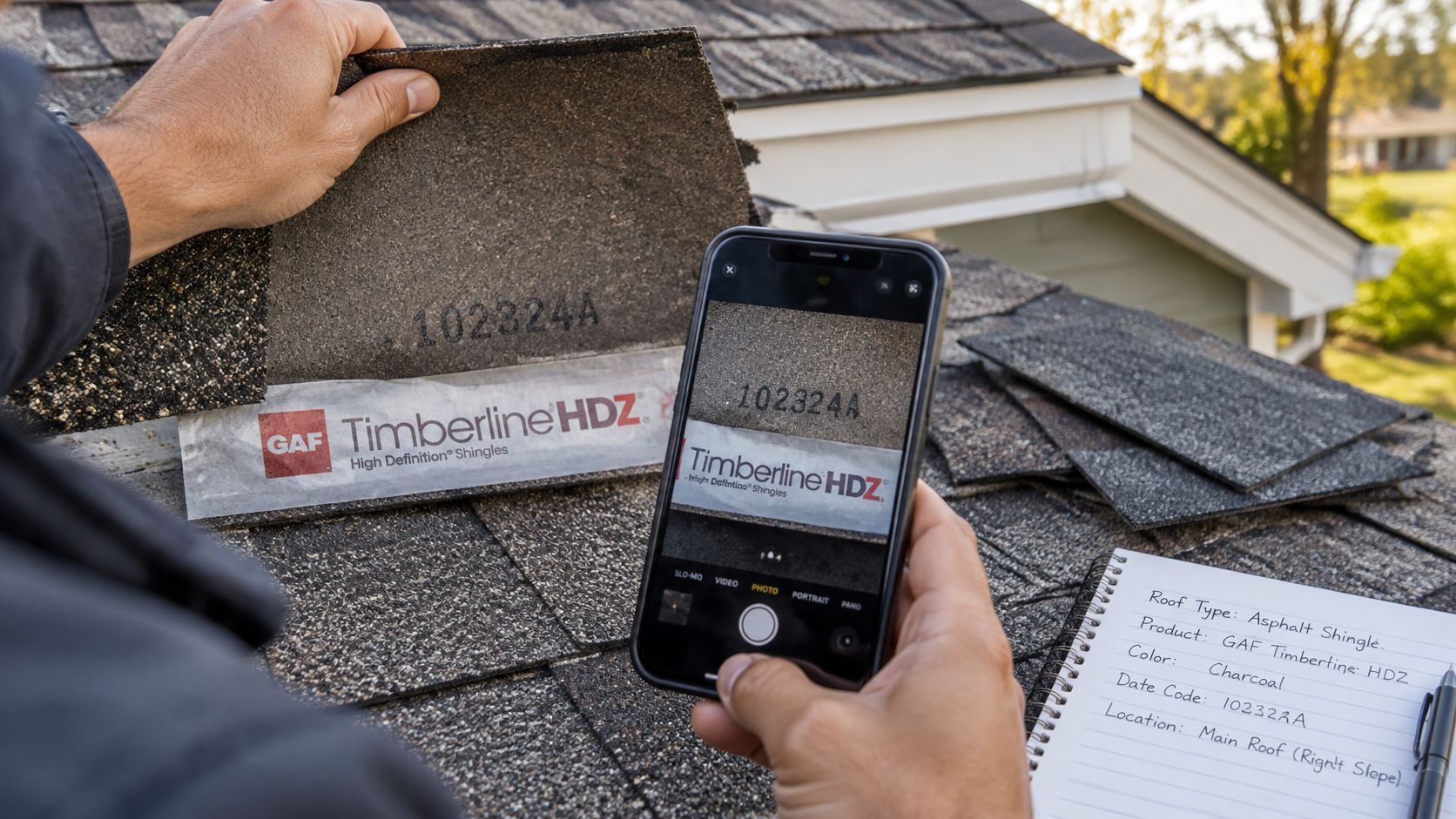
Identify the product first
Check the shingle name, any surviving wrapper, and any stamp or date code on the back of a lifted tab. Record whether the roof has three-tab shingles, architectural laminate such as GAF Timberline HDZ, or another system. A stamp may indicate when the product was made, but not when it was installed. Shingles can remain in storage before use.
Photograph each slope, then capture details at ridges, valleys, penetrations, and flashing. Close-ups of granules, tabs, and metal help show the condition supporting your estimate. The Arizona roofing-industry bulletin on asphalt shingles explains that ASTM D3462 compliance testing concerns product condition around manufacture and before installation, not shingles after they have been in service. That standard cannot establish a roof's age.
What the surface can and cannot say
| Indicator | What it suggests | Rough age band |
|---|---|---|
| Granules largely gone, mat exposed in gutters | Late-stage wear near end of service | 20+ years |
| Widespread curling or cupping | Aging shingles losing seal | 15 to 20 years |
| Brittle tabs that crack when lifted | Late-stage aging | 20+ years |
| Isolated blistering or a few repaired areas | Localized damage, not age alone | Not age-dependent |
| Moss or algae streaks without wear | Moisture and shade, not reliable for age | Not reliable for age |
| Uniform color and intact granules on a single layer | Likely younger roof; verify with records | Under 10 years |
Treat these bands as visual estimates, not dates. Shingle wear varies, so no single surface sign proves when the roof was installed. A typical roof life span can help frame expectations for a product class, but it cannot replace a missing permit or establish the installation year.
Separate maintenance needs from signs of broader system failure. Damaged gutters, fascia, or drip edge can be repaired without proving the roof has failed. Widespread granule loss, exposed fibers, significant curling or splitting, persistent valley, hip, or ridge leaks, failed underlayment, and a soft deck are stronger signs of end-of-service condition. Moss or algae alone gives little indication of age. Shade and moisture can produce streaks on roofs of different ages.
Record granule loss, exposed mat, curling, brittle tabs, blistering, repaired areas, and soft deck zones. State the estimated range, confidence level, and areas you could not inspect. That gives the insurer a clear basis for reviewing the estimate without presenting a visual guess as an installation date.
A visual estimate is a range with a confidence level. It is not an installation date.
Attic Checks That Confirm or Challenge an Estimate
The attic shows layers and deck history that a shingle face hides. Verisk's remaining-life analysis separates roof age (the install or replacement date) from current condition, and it reports that 29% of U.S. homes with asphalt shingles have fewer than four years of remaining useful life. In Columbus and central Ohio, hail repairs often replace damaged planes only. One age for the whole house can be false.
A short, safe pass
Stay on the joists. Do not step on insulation. A flashlight and a phone are enough for a ten-minute look.
- Nail tips through the sheathing: Tips that stick well past the deck often mean an older fastening pattern or a repair, not a brand-new nailing job.
- Stains and dark rings: Water marks around rafters and vents record past leaks. They do not, by themselves, date the shingles.
- Layer count at the eaves: A second course at the drip edge usually means an older roof was overlaid instead of torn off.
- Mismatched sheathing: Plywood next to older boards, or underlayment that changes color between bays, points to a partial replacement.
- Ventilation parts: Missing baffles, blocked soffits, or no ridge vent speed aging. Photograph them. They explain wear that looks older than the permit.
- Soft deck: Press gently. Springy zones mean moisture in the sheathing, which is a condition problem even when the surface date is recent.
Partial replacements and extra layers mean one roof can hold several ages. Date each section on its own line.
If the south slope was replaced after a storm and the north slope was not, write two dates. An insurer that prices the whole roof off the older plane will depreciate a claim differently than one that accepts the newer plane's paperwork. The attic is where you prove that split before anyone argues about granules.
Confirm the Age Your Insurer Will Use Before You Renew
The Insurance Information Institute reports that if a roof is more than 20 years old when someone applies, most insurers require an inspection, and some decline to write the policy. If an older roof is accepted, roof-loss payments may be limited to actual cash value rather than replacement cost. Subtract the install year from 2026, then compare that age with the carrier's inspection threshold before you assume you are inside it.
Carrier Management's report of Verisk findings says 38% of U.S. homes showed moderate-to-poor roof condition in 2025, with approximately 60% higher loss costs than homes rated good or excellent. The same reporting notes that roof age and material can push a carrier toward actual cash value, an inspection, an exclusion, or a decline, and that roofs older than roughly 15 to 20 years may face particularly restrictive treatment.
A newer roof is not automatically lower risk. Installation quality, flashing, ventilation, and storm exposure sit beside the date. If an automated age looks wrong, send the dated permit, the invoice, photographs, and a signed inspection, then ask which evidence the carrier accepts and how it reached its figure. Homes without records still need a licensed inspection that states condition and remaining service life. A contractor such as HIBCO ROOF LLC can document shingle type, an approximate range, and photos without certifying a year the paper does not support.
Coastal carriers often want wind documentation in the same file as roof age. A coastal homeowner's guide to insurance savings shows how a wind mitigation report sits next to roof records. The parallel for any market is the same: confirm the age and the valuation method in writing before renewal. Read how actual cash value differs from replacement cost on a roof so the number on the declarations page matches the number you can prove.
HIBCO ROOF LLC inspects residential roofs in Columbus and central Ohio, records shingle type and condition with photos, and helps homeowners assemble the permits, invoices, and section dates insurers ask for. If you need a written look at age range, storm damage, or a repair versus replacement estimate, start with a free inspection. Visit HIBCO ROOF LLC to request that visit and put a documented roof age in the file before renewal.